
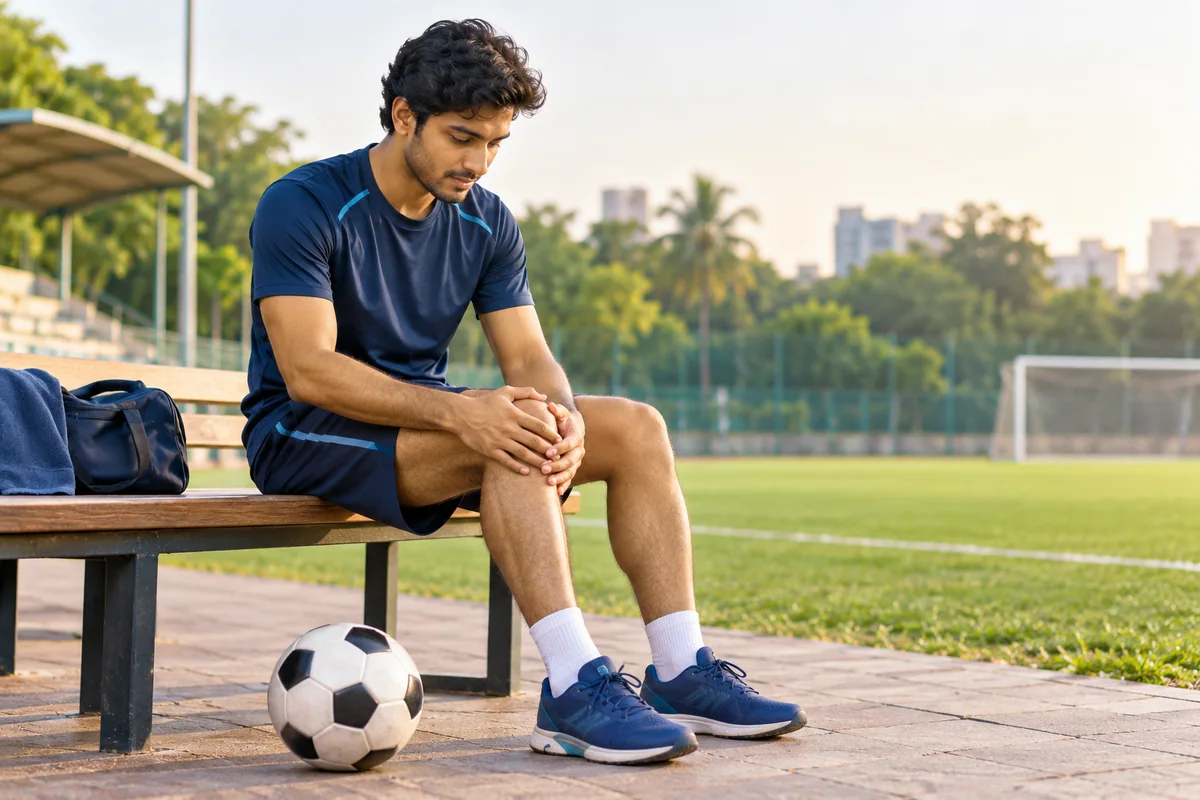
The featured image and supporting patient illustrations are AI-generated and do not depict actual patients.
ASPC Patient Education · Updated 26 October 2026
At a glance
An ACL injury affects a major stabilising ligament inside the knee. Rehabilitation restores swelling control, movement, strength and sport-specific function. Surgery decisions depend on instability, associated injuries and the person’s activity goals.
General patient information. Diagnosis and treatment should be individualized by a qualified healthcare professional.
Get help promptly: A locked knee, severe swelling or inability to bear weight needs prompt assessment.
In this guide
- What Is the ACL?
- Structures Often Injured Together with the ACL
- What Causes an ACL Injury?
- ACL Injury Symptoms
- Severity of ACL Injury
- ACL Tear vs Other Common Knee Injuries
- How Is an ACL Injury Assessed?
- Why Choosing the Right Treatment Matters
- Surgery or Rehabilitation First?
- Physiotherapy for an ACL Injury
- A Structured Treatment Approach
- Structural Diagnosis and Management (SDM) for ACL Injury
- The ACL Rehabilitation Roadmap
- ACL Injury Exercises
- Should You Exercise During Pain?
- Managing a Flare-Up or Swollen Knee
- Prevention of ACL Injury
- When to See a Physiotherapist or Doctor ?
- Final Takeaway
- A torn ACL does not mean the end of sport. Smart rehabilitation gets back stronger.
- Acute injury, chronic instability and perturbation training
- Why do women have a higher ACL injury risk in some sports?
- Common questions
- References and clinical guidance
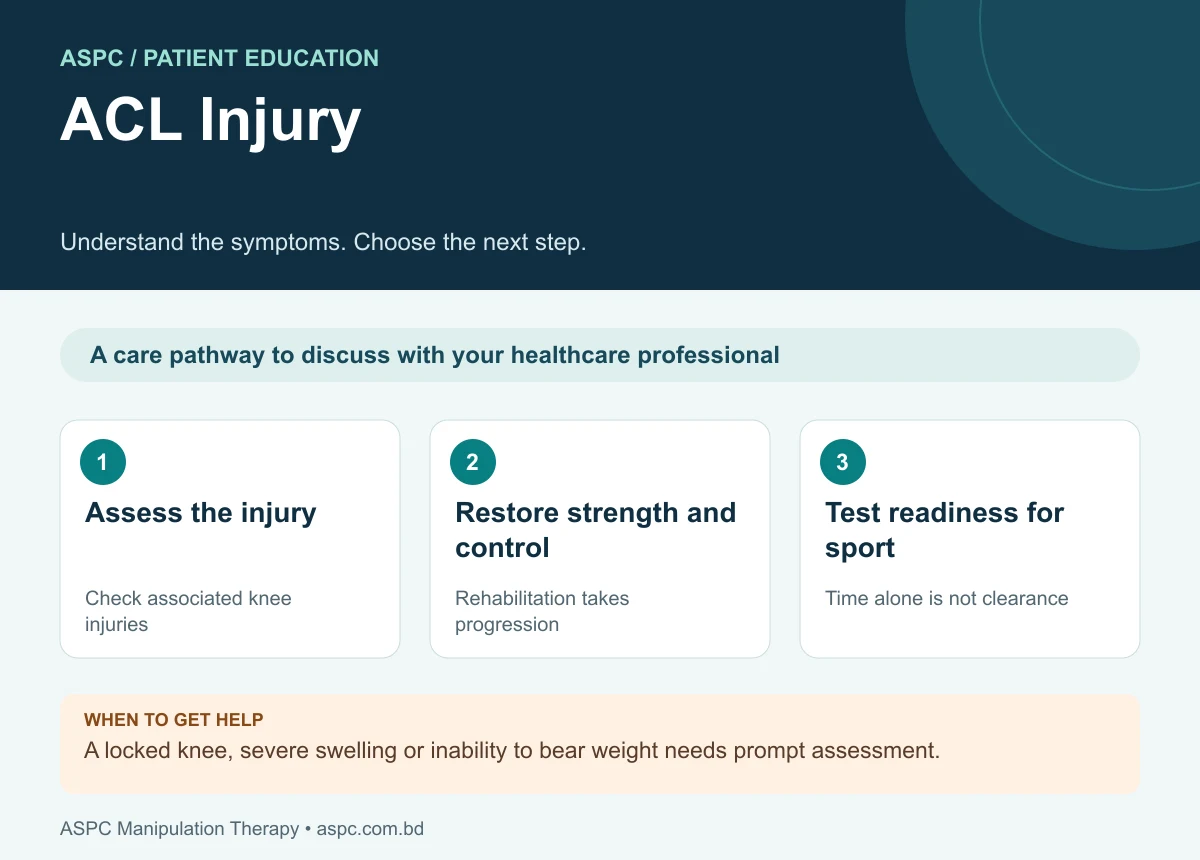
- Assess the injury: Check associated knee injuries.
- Restore strength and control: Rehabilitation takes progression.
- Test readiness for sport: Time alone is not clearance.
An anterior cruciate ligament (ACL) injury is a serious knee injury seen particularly in sports involving jumping, cutting and pivoting. Many occur without direct contact. Recovery usually requires structured, criteria-based rehabilitation, with or without reconstructive surgery (Logerstedt et al., 2017; Frobell et al., 2010).
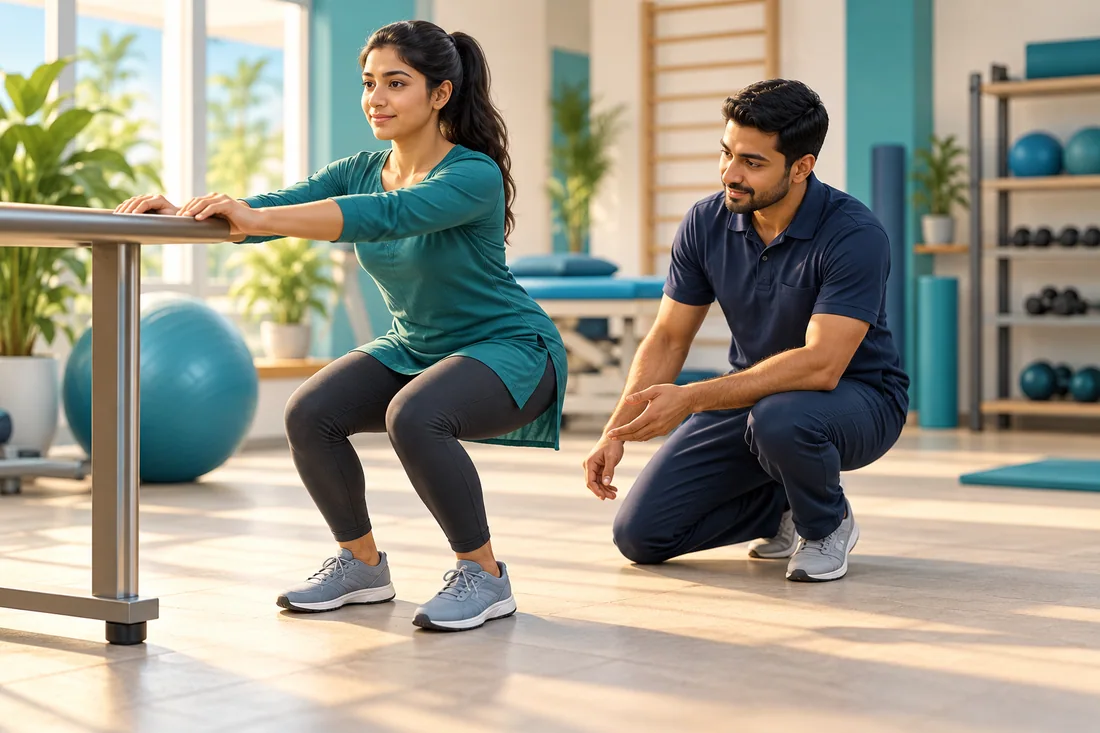
The featured image and supporting patient illustrations are AI-generated and do not depict actual patients.
What Is the ACL?
The ACL is a strong band of connective tissue running from the back of the thigh bone (femur) to the front of the shin bone (tibia). Together with the posterior cruciate ligament (PCL), it forms a cross inside the joint. Its main jobs are to stop the shin sliding forward, to control rotation and to help the knee feel steady during cutting, landing and changing direction (Logerstedt et al., 2017).
Structures Often Injured Together with the ACL
- Menisci (cartilage shock absorbers of the knee)
- Medial collateral ligament (MCL) on the inner side of the knee
- Articular cartilage and the bone beneath it (bone bruising)
- Muscles around the knee, which often weaken and switch off after injury
Treatment should therefore address stability, strength, movement control and confidence, not just the torn ligament (Logerstedt et al., 2017).
What Causes an ACL Injury?
Most ACL tears occur during sudden stopping, cutting, pivoting or an awkward landing. Others follow a direct blow or a knee forced beyond its normal range. Risk is higher with poor landing control, weak hip and thigh muscles, previous ACL injury, and in female athletes, who have a higher rate in many sports. A risk factor does not make an injury certain .
ACL Injury Symptoms
A feeling or sound of a “pop”, immediate pain that stops play, rapid swelling within a few hours, a feeling that the knee gives way, loss of full movement, and difficulty walking or turning confidently. Symptoms often settle after a few weeks, but the knee may still give way during sport or twisting (Logerstedt et al., 2017).
Severity of ACL Injury
Grade 1 : It is a mild sprain with the ligament stretched but intact.
Grade 2 : It is a partial tear, which is uncommon.
Grade 3 : It is a complete tear and is by far the most common serious form.
ACL Tear vs Other Common Knee Injuries
| Feature | ACL tear | Meniscus tear | MCL sprain |
|---|---|---|---|
| Typical cause | Pivot, sidestep, awkward landing, hyperextension | Twisting on a bent, loaded knee | Blow to the outer knee or a valgus (knock-knee) twist |
| Sound / onset | Often a “pop”, immediate pain, swelling within hours | May be delayed; swelling over a day or so | Pain on the inner knee, mild to moderate swelling |
| Main complaint | Knee gives way or feels unstable | Catching, locking, joint-line pain | Inner-knee pain and tenderness |
| Key test | Lachman, anterior drawer, pivot shift | Joint-line tenderness, McMurray, Thessaly | Valgus stress test |
| Usual course | Rehabilitation, with or without reconstruction | Rehabilitation, sometimes repair or trimming | Usually heals with rehabilitation |
Sources: Logerstedt et al. ; Benjaminse et al. .
How Is an ACL Injury Assessed?
Diagnosis is mainly clinical, based on the story of the injury and a hands-on examination. A thorough assessment typically includes:
- Injury history: mechanism, pop, swelling, giving way
- Swelling, range of motion and walking pattern
- Lachman, anterior drawer and pivot-shift tests, selected and interpreted by a trained clinician. Pain, swelling, guarding and injury timing can affect examination findings.
- Meniscus, MCL and other ligament tests
- Thigh, hip and calf strength, balance and movement control
MRI is used to confirm the diagnosis and to look for meniscus and cartilage damage, particularly when surgery is being considered. An X-ray cannot show the ligament but may be taken to rule out a fracture (Benjaminse et al., 2006; Logerstedt et al., 2017).
Why Choosing the Right Treatment Matters
Many people lose time with approaches that are incomplete or poorly structured. Common problems include:
- Resting the knee without rebuilding thigh and hip strength
- Returning to sport based on pain settling or on the calendar alone
- No neuromuscular, landing and balance retraining
- Surgery chosen without trying or discussing rehabilitation
- No long-term plan to prevent a second injury
Guidelines favour a structured, progressive, criteria-based programme matched to the person’s goals (Logerstedt et al., 2017).
Surgery or Rehabilitation First?
In a randomized trial of young, active adults with acute ACL tears, early reconstruction followed by rehabilitation was not better at two years than rehabilitation first, with surgery only if needed later (Frobell et al., 2010). Many people in the rehabilitation-first group did later choose surgery for instability. Reconstruction is more commonly recommended when the knee keeps giving way, for repeated pivoting or contact sport, or when other structures such as the meniscus are also torn. This decision should be made with an orthopaedic surgeon and physiotherapist.
Physiotherapy for an ACL Injury
Physiotherapy is central to ACL care before and after surgery. A physiotherapist assesses swelling, movement, strength and movement control, then builds a progressive programme that restores full knee movement, rebuilds the thigh and hip muscles, retrains landing and cutting, and guides a safe return to activity (Logerstedt et al., 2017).
A Structured Treatment Approach
- Detailed clinical assessment: history, swelling, range of motion, ligament and meniscus tests, strength and function.
- Swelling and pain control: activity modification, elevation, gentle movement and guidance on safe loading.
- Regaining full extension and flexion: early restoration of knee straightening and gradual bending.
- Quadriceps, hamstring and hip strengthening: progressive resistance training, which is the foundation of recovery.
- Neuromuscular and balance training: landing, single-leg control, agility and perturbation drills.
- Gait and movement re-training: normal walking, then running, with correct knee alignment.
- Return-to-sport testing: strength and hop tests plus sport-specific drills before full return.
- Home exercise programme and monitoring: regular reassessment with exercises adjusted to progress.
Structural Diagnosis and Management (SDM) for ACL Injury
SDM is the assessment framework used at ASPC. It combines history, joint motion, muscle length and strength, and neurological examination to reach a structural diagnosis, then links that diagnosis to a plan of manual therapy, exercise and education (Haque et al., 2020). Applied to an ACL injury, the framework is used in the following way:
1. Structural examination of the knee:Ligament laxity (Lachman, anterior drawer), meniscus and MCL tests, swelling, joint mobility and the alignment of the hip, knee and ankle.
2. Differential diagnosis: Separating an ACL tear from meniscus, MCL, cartilage or patellar problems, with referral for MRI or an orthopaedic opinion when the knee is locked, grossly unstable or the picture is atypical.
3. Muscle length and strength profile: Quadriceps, hamstring, calf and hip strength, and tight or restricted structures that overload the knee.
4. Diagnosis-led plan: Gentle joint and soft-tissue techniques where stiffness limits movement, combined with progressive strengthening, balance and landing training, and education about safe loading.
5. Regular reassessment: The plan is changed as swelling, range, strength and control improve, and the return-to-sport criteria are tested objectively.
Evidence: No trial of SDM in ACL injury is cited here, and SDM does not repair a torn ligament. In 64 adults with plantar heel pain, SDM improved pain, function and ankle motion (Akter et al., 2024), which may not apply to the knee. For ACL injury, the strongest evidence supports progressive, criteria-based exercise rehabilitation, with surgery considered for persistent instability or high-demand pivoting sport (Logerstedt et al., 2017; Frobell et al., 2010).
The ACL Rehabilitation Roadmap
Recovery is built in phases. Moving to the next phase should depend on meeting goals such as swelling control, full movement, strength and good movement quality, not only on the number of weeks.
Return-to-sport timing and readiness both matter. A cohort study associated later return to pivoting sport and meeting functional criteria with fewer subsequent knee injuries. Its results are associations, not a guarantee for an individual athlete. Readiness assessment should include strength, hop or movement tasks, symptoms, psychological readiness and sport demands (Grindem et al., 2016).
ACL Injury Exercises
Exercise is the foundation of recovery and prevention, and should be individualized and progressed by a physiotherapist. Commonly used early exercises include:
- Heel slides and knee extension: restore full movement.
- Straight-leg raises and quadriceps activation: wake up the thigh muscle.
- Mini squats, step-ups and bridges: build strength with good knee alignment.
- Single-leg balance: retrain control, progressing to unstable surfaces.
- Landing, hopping and change-of-direction drills: added only when the knee is ready.
Should You Exercise During Pain?
Usually yes, in a controlled way. Mild temporary muscle soreness is expected. Sharp pain, a new feeling that the knee gives way, locking, or swelling that increases after exercise should not be pushed through, and the programme should be adjusted. Your physiotherapist can set the starting level, repetitions and progression (Logerstedt et al., 2017).
Managing a Flare-Up or Swollen Knee
- Reduce the activity that caused the swelling for a short time
- Elevate the leg and keep the knee gently moving
- Avoid long periods of complete rest
- Continue home exercises at a lower level if tolerated
- Return gradually to normal activity
- Seek advice if swelling, pain or giving way is persistent or worsening
Prevention of ACL Injury
Neuromuscular training programmes that combine strengthening, landing technique, balance and agility drills reduce the risk of ACL injury, particularly in female athletes . Good habits include warming up before sport, landing softly with bent knees and hips, keeping knees in line with the toes, strengthening hips and thighs, and not returning to sport while fatigued or incompletely rehabilitated. After an ACL injury, the risk to both knees is higher, so prevention continues for life.
When to See a Physiotherapist or Doctor ?
Physiotherapist: knee instability, recurrent giving way, persistent swelling or stiffness after a knee injury, or wanting a structured rehabilitation or return-to-sport plan.
Doctor urgently: a deformed knee, inability to bear weight, a locked knee that will not straighten, a cold, pale or numb foot, fever with a hot swollen knee, severe uncontrolled pain, or injuries involving significant trauma (Logerstedt et al., 2017).
Final Takeaway
An ACL injury is serious, but it is not the end of an active life. Recovery depends on accurate assessment, a considered decision about surgery, and a well-structured rehabilitation programme that rebuilds strength, control and confidence. Return to sport should be earned by meeting objective criteria, not by the calendar, and prevention training reduces the chance of a second injury.
A torn ACL does not mean the end of sport. Smart rehabilitation gets back stronger.
Acute injury, chronic instability and perturbation training
Early after an ACL injury, the priorities include fracture or associated-injury screening, swelling control, comfortable walking and recovery of knee motion and muscle activation. A long-standing ACL-deficient knee may have less pain but continue to give way. Recurrent instability, locking or associated meniscal injury can change the rehabilitation and surgical discussion.
Perturbation training uses small, controlled and progressively less predictable balance challenges to practise the response to a disturbance. It can be one part of neuromuscular training for selected people with an ACL-deficient or reconstructed knee. It should be supervised and matched to healing status, knee control and associated injuries. An unstable surface is not appropriate at every stage, and perturbation drills do not replace progressive strength and functional testing.
After reconstruction, graft choice and any meniscus or cartilage procedure can affect precautions and exercise progression. Follow the surgeon and physiotherapist’s plan. Return to pivoting sport requires more than pain relief or elapsed time; assess swelling, movement, strength, movement quality and readiness for sport-specific demands.
Aspetar rehabilitation guideline after ACL reconstruction.
Why do women have a higher ACL injury risk in some sports?
Women have higher ACL injury rates than men in several comparable pivoting sports, but no single explanation applies to everyone. Anatomy, exposure, previous injury, strength, landing and cutting control, and other biological and training factors may interact. Sex alone cannot predict an individual injury.
Prevention programmes combine strength, balance, landing technique, change-of-direction practice and regular sport-specific warm-ups. They should be used consistently by the whole relevant team rather than treating a risk factor as a diagnosis. People with a previous ACL injury also need a plan to reduce further injury risk.
APTA Orthopedics: knee and ACL injury-prevention guidelines.
Common questions
Does an ACL tear always need surgery?
No. Some people function well with rehabilitation, while others need reconstruction because of instability, associated injuries or pivoting-sport goals. Discuss the options with an orthopaedic specialist.
Can physiotherapy regrow a torn ACL?
Physiotherapy aims to restore movement, strength and functional stability. It should not be sold as a guaranteed way to regrow a fully torn ligament.
When can I return to sport?
Return depends on healing, strength, movement quality, functional tests and clinical clearance. A calendar date alone cannot establish readiness.
Assessment and rehabilitation in Dhaka
ASPC Manipulation Therapy provides physiotherapy assessment and rehabilitation in Dhaka. An appointment can help clarify your symptoms, current movement and strength, daily activity goals and whether medical referral is needed. Care should be individualized, with progress reviewed rather than a guaranteed recovery promise.
ASPC describes its assessment framework as Structural Diagnosis and Management (SDM). A named framework does not establish effectiveness for every condition. Treatment choices should follow the clinical findings, relevant guidance and the person’s preferences.
Discuss an assessment with ASPC
Related patient guides
- Osteoarthritis: Symptoms, Exercise and Treatment Options
- Knee Pain: Causes, Symptoms, Exercises and Treatment
Related background: knee pain guide.
References and clinical guidance
Guidelines inform general care; studies have specific populations and limitations. The SDM framework description and plantar-heel-pain trial should be read in their own clinical context.
- AAOS OrthoInfo patient guidance
- Benjaminse, Gokeler, van der Schans (2006). Clinical Diagnosis of an Anterior Cruciate Ligament Rupture: A Meta-analysis. Journal of Orthopaedic & Sports Physical Therapy.
- Frobell, Roos, Roos et al. (2010). A Randomized Trial of Treatment for Acute Anterior Cruciate Ligament Tears. New England Journal of Medicine.
- Grindem, Snyder-Mackler, Moksnes et al. (2016). Simple decision rules can reduce reinjury risk by 84% after ACL reconstruction: the Delaware-Oslo ACL cohort study. British Journal of Sports Medicine.
- Logerstedt, Scalzitti, Risberg et al. (2017). Knee Stability and Movement Coordination Impairments: Knee Ligament Sprain Revision 2017. Journal of Orthopaedic & Sports Physical Therapy.
- Haque (2020). Treating Mechanical Dysfunctions of Lower Back through Lumbar Spine Assessment of Structural Diagnosis and Management (SDM): A New Comprehensive Approach of Musculoskeletal Medicine. American Journal of Biomedical Science & Research.
- Akter, Hossain, Hossain et al. (2024). Comparison of Structural Diagnosis and Management (SDM) approach and MyoFascial Release (MFR) for improving plantar heel pain, ankle range of motion and disability: A randomized clinical trial. Journal of Manual & Manipulative Therapy.
- Aspetar guideline on rehabilitation after ACL reconstruction
Content restored and references checked: 26 October 2026. This editorial check does not replace individual clinical assessment. Medical information disclaimer.