

The featured image and supporting patient illustrations are AI-generated and do not depict actual patients.
ASPC Patient Education · Updated 26 October 2026
At a glance
Neck pain may involve local muscles and joints or irritation of nerves supplying the arm. Treatment depends on the symptom pattern and usually includes comfortable movement, progressive exercise and practical activity changes.
General patient information. Diagnosis and treatment should be individualized by a qualified healthcare professional.
Get help promptly: Major injury, worsening weakness or new balance problems require medical assessment.
In this guide
- What Is Neck Pain?
- Structures That Can Contribute to Neck Pain
- What Causes Neck Pain?
- Neck Pain Symptoms
- Mechanical Neck Pain vs Nerve-Related (Radicular) Pain
- Pain Does Not Always Match the MRI
- How Is Neck Pain Assessed?
- Why Choosing the Right Treatment Matters
- Physiotherapy for Neck Pain
- A Structured Treatment Approach
- Neck Pain Exercises
- Should You Exercise During Pain?
- Posture, Ergonomics and Lifestyle
- Medication, Injections and Surgery
- Managing a Neck Pain Flare-Up
- Prevention and Long-Term Management
- When to See a Physiotherapist or Doctor
- Final Takeaway
- Neck pain does not mean you have to stop moving.
- Common questions
- References and clinical guidance
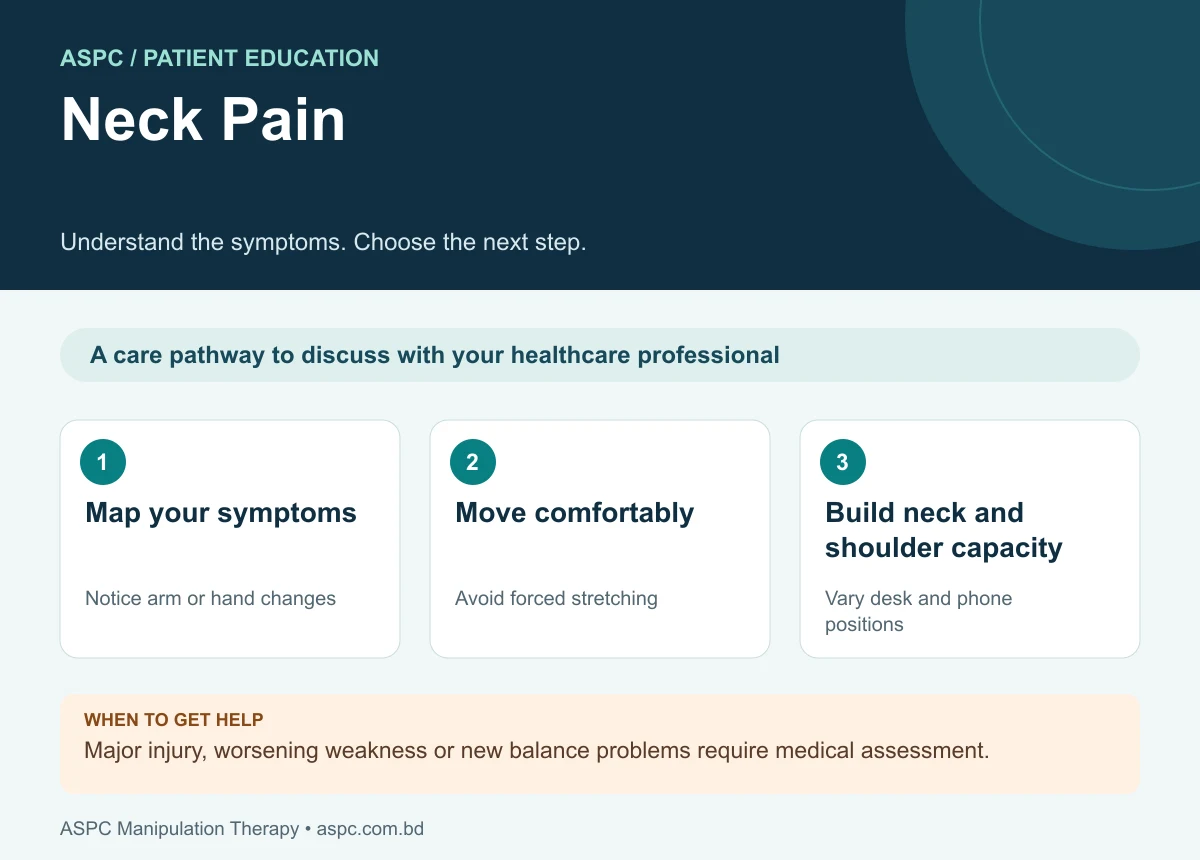
- Map your symptoms: Notice arm or hand changes.
- Move comfortably: Avoid forced stretching.
- Build neck and shoulder capacity: Vary desk and phone positions.
Neck pain is one of the most common musculoskeletal complaints worldwide and a frequent reason for seeking physiotherapy (Hoy et al., 2014). In Dhaka, long hours at a computer, constant smartphone use, poor posture and stress make it especially familiar. Most neck pain is mechanical rather than caused by serious disease, and many people recover well with education, exercise, manual therapy and sensible activity changes, without surgery (Blanpied et al., 2017; Côté et al., 2016).

The featured image and supporting patient illustrations are AI-generated and do not depict actual patients.
What Is Neck Pain?
Neck pain is a symptom, not a single disease. The cervical spine has seven vertebrae that support the head, protect the spinal cord and allow bending, extension and rotation. Because it carries the head while staying highly mobile, it is vulnerable to postural strain, repetitive load, degenerative change and injury (Cohen, 2015). Pain may stay in the neck or spread to the shoulder, upper back, head or arm.
Structures That Can Contribute to Neck Pain
- Inter-vertebral discs and facet joints
- Ligaments and joint capsules
- Muscles and tendons of the neck, upper back and shoulder girdle
- Cervical nerve roots
- Upper thoracic spine and shoulder girdle, which influence neck load
Treatment should therefore address pain, joint mobility, muscle control, posture and function, not one structure alone .
What Causes Neck Pain?
Common contributors include prolonged poor posture, repetitive strain, muscle imbalance or weakness, joint stiffness, age-related disc and joint change, nerve irritation, and injury such as whiplash. Psychological stress and poor sleep can also amplify pain (Cohen, 2015; Côté et al., 2016). A risk factor does not make neck pain certain, and age-related changes alone do not always cause symptoms.
Neck Pain Symptoms
Pain, stiffness, muscle tightness, reduced turning or bending, headache from the neck, and pain spreading to the shoulder or upper back. When a nerve root is irritated there may also be arm pain, numbness, tingling or weakness (Binder, 2007; Cohen, 2015). Symptoms often fluctuate, with flare-ups after sustained postures or stress.
Mechanical Neck Pain vs Nerve-Related (Radicular) Pain
| Feature | Mechanical neck pain | Nerve-related (radicular) pain |
|---|---|---|
| Main site | Neck, may spread to shoulder or upper back | Arm pain, often equal to or greater than neck pain |
| Neurological symptoms | Usually absent | Numbness, tingling or weakness in arm or hand |
| Typical trigger | Posture, sustained positions, movement | Certain neck positions that load the nerve root |
| Management | Exercise, manual therapy, education | Same, with neurological monitoring and medical review if deficits progress |
Sources: Binder ; Cohen .
Pain Does Not Always Match the MRI
Disc degeneration and other MRI abnormalities are very common in people with no neck pain, and become more frequent with age (Nakashima et al., 2015). Some people with minimal findings have severe pain, while others with marked changes have none. Reports must therefore be read alongside the clinical picture rather than used alone to explain symptoms
How Is Neck Pain Assessed?
Diagnosis is mainly clinical, based on history, examination and function. A thorough assessment typically includes:
- Symptom history and aggravating or easing factors
- Postural analysis
- Cervical range of motion and joint mobility testing
- Muscle strength and deep neck flexor control
- Neurological screening
- Functional movement analysis
Imaging (X-ray, MRI) is not routinely needed. It is considered after significant trauma, when serious pathology or progressive neurological signs are suspected, when the diagnosis is uncertain, or when surgery is being considered (Blanpied et al., 2017; Côté et al., 2016).
Why Choosing the Right Treatment Matters
Many people rely only on short-term relief. Approaches that are incomplete or poorly structured tend to share common problems:
- Over-reliance on pain medication
- Passive modalities without active rehabilitation
- No individualized exercise program
- Manipulation without adequate assessment
- No long-term plan to prevent recurrence
Guidelines instead favour education, exercise and manual therapy, matched to each person’s presentation (Blanpied et al., 2017; Côté et al., 2016).
Physiotherapy for Neck Pain
Physiotherapy is a core part of neck pain care. A physiotherapist assesses posture, movement, strength and nerve involvement, then builds a progressive program that reduces pain, restores movement, strengthens supporting muscles and teaches self-management (Blanpied et al., 2017).
A Structured Treatment Approach
- Detailed clinical assessment: history, posture, mobility, strength, neurological screening and functional movement.
- Structural Diagnosis and Management (SDM): an assessment-led framework used to reach a structural diagnosis and plan treatment (see below).
- Pain and irritability management: education about safe movement, temporary activity modification and gentle techniques to settle irritated tissue.
- Manual therapy: cervical and upper thoracic joint mobilization and soft-tissue techniques to improve mobility and reduce muscle tension, used alongside exercise .
- Deep neck stabilization exercises: training of the deep cervical flexors and supporting muscles (Jull et al., 2008).
- Shoulder and upper back rehabilitation: scapular stabilization, upper thoracic mobility and postural muscle training.
- Posture and ergonomic correction: sitting posture, screen height, safe smartphone use and workstation set-up.
- Functional movement re-training: gradual return to work and daily activities without triggering pain.
- Customized home exercise program: to maintain strength and flexibility and prevent recurrence.
- Continuous monitoring: regular reassessment, with exercises and intensity adjusted as the patient progresses.
Structural Diagnosis and Management (SDM)
SDM is the assessment framework used at ASPC. It combines history, joint motion, muscle length and strength, and neurological examination to reach a structural diagnosis, then links the diagnosis to a plan of manual therapy, exercise and education (Haque et al., 2020). Applied to the neck, this means a structural examination, differential diagnosis (with referral if the presentation is atypical), a diagnosis-led plan and regular reassessment.
Evidence: No neck-pain trial of SDM is cited here. In 64 adults with plantar heel pain, SDM improved pain, function and ankle motion (Akter et al., 2024), which may not apply to the neck. For neck pain generally, mobilization or manipulation combined with exercise may help some patients, although evidence quality varies , and guidelines place exercise at the centre of care (Blanpied et al., 2017).
Neck Pain Exercises
Thoracic mobility: extension and rotation work for Exercise is among the best-supported treatments for neck pain and should be individualized . Commonly used exercises include:
- Deep neck flexor training: gentle chin-nod (craniocervical flexion) exercises, progressed gradually (Jull et al., 2008).
- Scapular and upper back strengthening: retraction, rows and shoulder stabilization.
- the upper back.
- Neck mobility: gentle, pain-limited range-of-motion exercises done regularly.
- General activity: walking or cycling to keep the whole body conditioned.
Should You Exercise During Pain?
Usually yes, in a controlled way. Mild temporary discomfort can be expected, but severe, spreading or worsening pain, or new arm symptoms, should not be pushed through. A physiotherapist can set the starting level, repetitions and progression (Blanpied et al., 2017).
Posture, Ergonomics and Lifestyle
Desk and phone habits strongly influence neck load. Practical steps include placing the screen near eye level, supporting the lower back, bringing the phone up rather than bending the head down, and changing position and taking short movement breaks regularly. Posture advice works best combined with exercise rather than on its own (Côté et al., 2016). Sleep, stress management and general fitness also matter.
Medication, Injections and Surgery
Medication may give short-term symptom relief and help people stay active, but it does not correct the underlying mechanical problem; choice depends on age, other conditions and other medicines, so clinician guidance is needed (Côté et al., 2016; Cohen, 2015). Surgery is uncommon and is generally reserved for progressive neurological deficit or severe nerve-related pain that does not respond to conservative care (Cohen, 2015).
Managing a Neck Pain Flare-Up
- Temporarily reduce aggravating positions and activities.
- Avoid prolonged rest or neck immobilization.
- Keep moving gently within comfort.
- Follow your pain-relief plan and home exercises.
- Return gradually to normal activity.
- Seek advice if pain is severe or persistent.
Prevention and Long-Term Management
Neck pain often recurs, so long-term habits matter: regular neck, shoulder and upper back exercise, workstation and phone ergonomics, movement breaks, good sleep and stress control, and early action when symptoms return. Consistency beats occasional intensity (Blanpied et al., 2017; Côté et al., 2016).
When to See a Physiotherapist or Doctor
Physiotherapist: persistent or recurring neck pain, increasing stiffness, headaches from the neck, desk-related strain, or wanting a structured plan.
Doctor urgently: significant trauma, sudden severe pain or headache, fever, unexplained weight loss, a history of cancer, progressive arm or leg weakness, clumsy hands, balance or walking problems, bladder or bowel changes, or anything atypical (Binder, 2007; Blanpied et al., 2017)
Final Takeaway
Neck pain is a symptom with many possible sources, and treatment should follow the individual clinical picture, not the scan alone. The non-surgical foundation is accurate assessment, education, therapeutic exercise, manual therapy, posture and ergonomic correction, and a long-term prevention plan. Medication helps selected patients for a short time; surgery is rarely needed and is reserved for specific situations.
Neck pain does not mean you have to stop moving.
Common questions
Can cervical spondylosis cause neck pain?
Age-related changes can contribute to symptoms, but changes on a scan are also common without pain. Treatment should be based on symptoms and examination rather than the scan alone.
Can neck pain cause a headache?
Some headaches are related to neck structures, but many have other causes. A sudden severe or unusual headache needs medical evaluation.
Should I wear a neck collar?
Routine collar use is generally unnecessary for ordinary neck pain unless a clinician advises it for a specific reason. Comfortable movement and an individualized exercise plan are usually preferable.
Assessment and rehabilitation in Dhaka
ASPC Manipulation Therapy provides physiotherapy assessment and rehabilitation in Dhaka. An appointment can help clarify your symptoms, current movement and strength, daily activity goals and whether medical referral is needed. Care should be individualized, with progress reviewed rather than a guaranteed recovery promise.
ASPC describes its assessment framework as Structural Diagnosis and Management (SDM). A named framework does not establish effectiveness for every condition. Treatment choices should follow the clinical findings, relevant guidance and the person’s preferences.
Discuss an assessment with ASPC
Related patient guides
- Frozen Shoulder: Symptoms, Causes, Recovery and Treatment
- Deltoid Tendinitis: Outer Shoulder Pain and Rehabilitation
Related assessment and rehabilitation guides
References and clinical guidance
Guidelines inform general care; studies have specific populations and limitations. The SDM framework description and plantar-heel-pain trial should be read in their own clinical context.
- NHS condition-specific patient guidance
- Binder (2007). Cervical spondylosis and neck pain. BMJ.
- Cohen (2015). Epidemiology, Diagnosis, and Treatment of Neck Pain. Mayo Clinic Proceedings.
- Hoy, March, Woolf et al. (2014). The global burden of neck pain: estimates from the Global Burden of Disease 2010 study. Annals of the Rheumatic Diseases.
- Blanpied, Gross, Elliott et al. (2017). Neck Pain: Revision 2017. Journal of Orthopaedic & Sports Physical Therapy.
- Côté, Wong, Sutton et al. (2016). Management of neck pain and associated disorders: A clinical practice guideline from the Ontario Protocol for Traffic Injury Management (OPTIMa) Collaboration. European Spine Journal.
- Nakashima, Yukawa, Suda et al. (2015). Abnormal Findings on Magnetic Resonance Images of the Cervical Spines in 1211 Asymptomatic Subjects. Spine.
- Gross, Langevin, Burnie et al. (2015). Manipulation and mobilisation for neck pain contrasted against an inactive control or another active treatment. Cochrane Database of Systematic Reviews.
- Gross, Kay, Paquin et al. (2015). Exercises for mechanical neck disorders. Cochrane Database of Systematic Reviews.
- Jull, O'Leary, Falla (2008). Clinical Assessment of the Deep Cervical Flexor Muscles: The Craniocervical Flexion Test. Journal of Manipulative and Physiological Therapeutics.
- Akter, Hossain, Hossain et al. (2024). Comparison of Structural Diagnosis and Management (SDM) approach and MyoFascial Release (MFR) for improving plantar heel pain, ankle range of motion and disability: A randomized clinical trial. Journal of Manual & Manipulative Therapy.
- Haque (2020). Treating Mechanical Dysfunctions of Lower Back through Lumbar Spine Assessment of Structural Diagnosis and Management (SDM): A New Comprehensive Approach of Musculoskeletal Medicine. American Journal of Biomedical Science & Research.
Content restored and references checked: 26 October 2026. This editorial check does not replace individual clinical assessment. Medical information disclaimer.