

The featured image and supporting patient illustrations are AI-generated and do not depict actual patients.
ASPC Patient Education · Updated 26 October 2026
At a glance
Pain over the deltoid region is not enough to diagnose deltoid tendinitis. Rotator cuff problems, bursitis, neck pain and injury can feel similar. Treatment should follow an assessment of the actual source of pain.
General patient information. Diagnosis and treatment should be individualized by a qualified healthcare professional.
Get help promptly: New inability to lift the arm after injury or chest symptoms needs urgent review.
In this guide
- What Is Deltoid Tendinitis?
- How Common Is It? Prevalence and Epidemiology
- Causes and Risk Factors
- Symptoms and Pain Location
- Does it cause muscle weakness?
- Stages and Recovery Time
- Stage 1: Irritable or painful phase
- Stage 2: Load rebuilding phase
- Stage 3: Return-to-function phase
- Assessment and Treatment: Structural Diagnosis and Management (SDM) at ASPC Manipulation Therapy
- Nutrition and Daily Tips
- Other Conditions and When to Get Help
- Final Takeaway
- Common questions
- References and clinical guidance
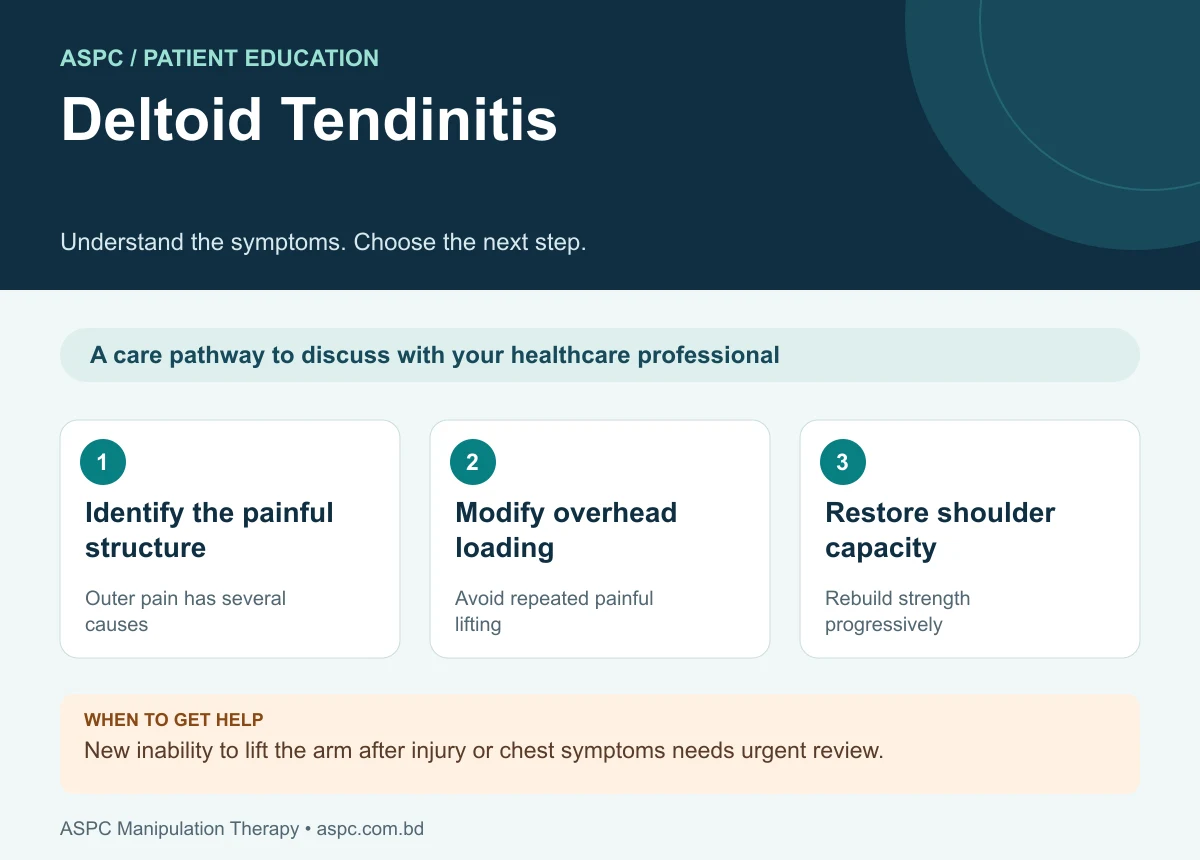
- Identify the painful structure: Outer pain has several causes.
- Modify overhead loading: Avoid repeated painful lifting.
- Restore shoulder capacity: Rebuild strength progressively.
Deltoid tendinitis, often described more broadly as deltoid tendinopathy, refers to pain and irritation involving the deltoid muscle’s tendon or its attachment around the shoulder. It may cause pain when lifting the arm, reaching overhead, carrying objects or performing repeated shoulder movements. Because pain in this region can also arise from rotator cuff disease, bursitis, acromioclavicular joint problems or referred neck pain, an accurate clinical assessment is important (Desmeules et al., 2025).

The featured image and supporting patient illustrations are AI-generated and do not depict actual patients.
Symptoms may develop after a sudden increase in activity, repeated loading or a direct injury, although a precise cause is not always identified. Management usually focuses on identifying the painful structure, temporarily modifying aggravating loads and gradually restoring shoulder strength and function. Evidence specific to isolated deltoid tendinitis is limited; therefore, rehabilitation principles for shoulder tendinopathy should be applied cautiously and individualized to the clinical findings (Desmeules et al., 2025).
What Is Deltoid Tendinitis?
The deltoid is the large, triangular muscle covering the shoulder. It arises from the lateral third of the clavicle, the acromion and the spine of the scapula, and inserts on the deltoid tuberosity of the humerus. Its anterior, middle and posterior portions contribute to shoulder flexion, abduction and extension, respectively, while working with other muscles to move and control the arm. The term “deltoid tendinitis” is commonly used for painful irritation around the deltoid’s tendon or attachment, but clinicians may use “tendinopathy” when the problem reflects load-related tendon pain without clear evidence of acute inflammation (Lewis, 2016).
Pain felt over the outer shoulder does not automatically mean that the deltoid tendon is the source. The rotator cuff, subacromial bursa, acromioclavicular joint and cervical spine can produce similar symptoms. Isolated deltoid insertional tendinopathy is not as well studied as rotator cuff tendinopathy, so diagnosis depends on the history, examination and exclusion of more likely causes rather than on the symptom location alone (Desmeules et al., 2025; Lewis, 2016).
How Common Is It? Prevalence and Epidemiology
The prevalence of isolated deltoid tendinitis is not well established in population studies, and there is no reliable worldwide estimate. Most epidemiological research on shoulder pain groups several disorders together or focuses on rotator cuff disease; figures for those conditions should not be presented as the prevalence of deltoid tendinitis (Desmeules et al., 2025).
It may be encountered in people whose work, sport or daily activities repeatedly load the shoulder, but the available evidence does not establish a specific age group, sex distribution or population prevalence for isolated deltoid tendinitis. Risk is better considered in relation to individual activity exposure, injury history and the clinical diagnosis.
| Group | Evidence status |
|---|---|
| Isolated deltoid tendinitis | No reliable population prevalence estimate |
| Shoulder pain / rotator cuff disorders | Studied more widely; figures are not deltoid-specific |
Shoulder pain is common, but current clinical guidance primarily addresses rotator cuff-related shoulder pain rather than isolated deltoid tendon disorders. Consequently, the table below distinguishes what is known from what remains uncertain; it should not be interpreted as a population estimate for deltoid tendinitis (Desmeules et al., 2025).
Causes and Risk Factors
Deltoid-region pain may follow repeated or unfamiliar loading, a rapid increase in training volume, direct trauma or work that requires frequent lifting. However, the same symptoms can arise from neighbouring shoulder structures. The diagnosis should therefore be based on a combination of symptom behaviour, examination findings and, when indicated, further investigation rather than on one presumed cause (Lewis, 2016; Desmeules et al., 2025).
- Repeated or increased loading: sudden increases in overhead exercise, throwing, lifting or repetitive work may exceed the shoulder’s current load tolerance. A temporal relationship supports the possibility of a load-related disorder but does not confirm that the deltoid tendon is responsible (Desmeules et al., 2025).
- Direct trauma or muscle injury: a blow, fall or forceful contraction may injure the deltoid muscle or its attachment. Marked bruising, swelling, sudden weakness or loss of active movement requires assessment for a more substantial injury .
- Insufficient recovery: repeatedly performing painful shoulder activity without adequate recovery may maintain symptoms. Relative rest means reducing provocative loads, not automatically immobilizing the shoulder for a prolonged period (Desmeules et al., 2025).
- Coexisting shoulder disorders: rotator cuff tendinopathy, subacromial pain, acromioclavicular joint disorders and glenohumeral conditions can mimic deltoid-region pain. These should be considered during differential diagnosis (Lewis, 2016; Desmeules et al., 2025).
- Postural, occupational and sporting demands: repetitive reaching, carrying loads away from the body and overhead sport can increase shoulder demand. These activities are potential load contributors, not proof of a specific tendon lesion (Desmeules et al., 2025).
- Age and general health: tendon symptoms can occur across adulthood. Evidence does not support a specific age or sex pattern for isolated deltoid tendinitis; clinicians should consider the person’s health, training history and functional demands.
Not everyone exposed to these factors develops symptoms, and pain around the deltoid may have a different cause. Persistent symptoms, significant weakness, traumatic onset or progressive loss of function warrant professional assessment to clarify the diagnosis (Lewis, 2016; Desmeules et al., 2025).
Symptoms and Pain Location
The main symptom is pain around the outer or lateral shoulder, particularly during activities that load or raise the arm. Symptoms alone cannot reliably identify the affected structure, so consider clinical assessment if you notice the following (Lewis, 2016; Desmeules et al., 2025):
- Pain over the lateral shoulder or near the deltoid attachment
- Pain when lifting the arm, reaching overhead or carrying an object
- Discomfort during repeated shoulder exercise, throwing or lifting
- Tenderness around the painful area, sometimes with pain after activity
- Difficulty with dressing, grooming, work tasks or sport because of shoulder pain
Pain may be felt over the deltoid region and upper arm. Pain that travels below the elbow, is associated with tingling or numbness, or changes substantially with neck movement may indicate cervical or nerve involvement rather than an isolated deltoid tendon problem (Lewis, 2016).
Urgent warning: Seek emergency medical care for shoulder or arm pain accompanied by chest pressure, shortness of breath, sweating, faintness or pain spreading to the jaw. Urgent assessment is also needed after major trauma, with visible deformity, a hot swollen joint with fever, or sudden profound weakness.
Does it cause muscle weakness?
Pain can temporarily inhibit muscle performance, and reduced activity may lead to deconditioning. However, obvious loss of strength, a sudden inability to raise the arm or a palpable defect should not be assumed to be simple tendinitis and needs medical assessment (Desmeules et al., 2025).
Stages and Recovery Time
Stage 1: Irritable or painful phase
Pain is prominent during the movements or loads that irritate the shoulder. The priority is to reduce the most provocative activities while maintaining comfortable movement and avoiding unnecessary prolonged immobilization. The duration varies between individuals; these phases are a practical description, not a validated staging system for deltoid tendinitis (Lewis, 2016).
Stage 2: Load rebuilding phase
As symptoms become more manageable, rehabilitation gradually increases shoulder movement and muscle loading. Exercise intensity should be adjusted to the response during activity and over the following day rather than progressed according to a fixed timetable (Desmeules et al., 2025).
Stage 3: Return-to-function phase
The person progressively resumes heavier work, overhead tasks or sport when movement, strength and load tolerance improve. Return should be based on function and symptom response, not simply the number of days since symptoms began (Desmeules et al., 2025).
There is no reliable, deltoid-specific recovery timeline. Recovery depends on the actual diagnosis, severity, duration of symptoms, activity demands, general health and consistency of a suitable rehabilitation plan. Worsening symptoms or little improvement despite appropriate care should prompt reassessment of the diagnosis and treatment strategy (Desmeules et al., 2025).
Assessment and Treatment: Structural Diagnosis and Management (SDM) at ASPC Manipulation Therapy
Treatment should begin with a careful assessment because pain over the deltoid may be caused by several different shoulder conditions. At ASPC Manipulation Therapy in Dhaka, the centre describes its approach as Structural Diagnosis and Management (SDM), a clinician-developed framework associated with musculoskeletal assessment. Evidence specific to using SDM for deltoid tendinitis has not been established; treatment choices should be guided by clinical findings and the broader evidence for shoulder pain rehabilitation (Haque et al., 2020; Desmeules et al., 2025).
How SDM assesses a painful deltoid region
The published SDM description emphasizes a systematic history and musculoskeletal examination, including joint motion, muscle length, strength and neurological screening. For suspected deltoid tendinopathy, these elements can help document symptoms and identify alternative causes, but no single examination test can independently confirm the diagnosis. The assessment may include (Haque et al., 2020; Desmeules et al., 2025):
- History and load analysis: clarify onset, trauma, recent changes in sport or work, aggravating and easing activities, night pain, previous shoulder problems and the patient’s functional goals.
- Structural and functional examination: inspect for swelling, bruising or deformity; assess active and passive shoulder range of motion, resisted shoulder movements, strength and tenderness. Findings should be interpreted together because pain during resisted abduction may also occur with rotator cuff disorders (Desmeules et al., 2025).
- Differential diagnosis and referral: consider rotator cuff disease, subacromial pain, acromioclavicular or glenohumeral disorders, cervical referral, nerve involvement and fracture or tear after trauma. Imaging is not routinely needed at the first visit for uncomplicated shoulder pain, but may be appropriate when a serious lesion is suspected or symptoms fail to improve with suitable care (Desmeules et al., 2025).
How SDM may guide management
- Diagnosis-led plan: choose interventions according to the clinical findings, irritability, activity requirements and patient goals. Do not assume every painful deltoid region requires the same manual technique or exercise protocol.
- Exercise and manual therapy: education, temporary activity modification and progressive therapeutic exercise are central options for many shoulder tendinopathies. Manual therapy may be used as an adjunct for short-term symptom relief when appropriate; it should not replace active rehabilitation. These recommendations are extrapolated mainly from rotator cuff-related shoulder pain, not from deltoid-specific trials (Desmeules et al., 2025).
- Regular reassessment: monitor pain, range of motion, strength, sleep and relevant activities. Increase load gradually when the response is acceptable, and revise the plan if function deteriorates or progress stalls.
- Pain relief and co-management: a clinician or pharmacist can advise whether short-term analgesics or anti-inflammatory medicines are suitable, taking account of medical history and contraindications. Do not self-prescribe injections or use pain relief to repeatedly push through worsening symptoms.
- Further medical care when needed: a clinician may request imaging or refer to a physician if there is significant trauma, marked weakness, suspected tear or fracture, systemic symptoms, or persistent pain and disability despite appropriate conservative management. Injection or surgery is not a routine treatment for presumed isolated deltoid tendinitis and should only be considered after a clear diagnosis and specialist discussion (Desmeules et al., 2025).
An honest note on the evidence: Isolated deltoid tendinitis is sparsely represented in clinical research, and there is no established deltoid-specific SDM outcome evidence identified for this document. The 2020 SDM publication describes a framework for lumbar mechanical dysfunction, while the available shoulder guideline focuses on rotator cuff tendinopathy. Therefore, SDM-based care at ASPC should be understood as the centre’s clinical approach, not as a proven, deltoid-specific treatment superior to other evidence-based options (Haque et al., 2020; Desmeules et al., 2025).
Nutrition and Daily Tips
No specific food cures tendinitis. A balanced diet with adequate energy, protein, fruits, vegetables and fluids supports general health and recovery. Individual dietary advice may be needed for people with medical conditions. Supplements should not be assumed to heal a tendon, and high-dose products should be discussed with a qualified healthcare professional.
Temporarily reduce the movements that reliably aggravate pain, but keep the shoulder moving within a comfortable range unless a clinician advises otherwise. Follow a gradual exercise plan, avoid sudden increases in training volume, take recovery breaks during repetitive work and return to sport progressively. Stop and seek advice if exercise causes sharp pain, new weakness or a sustained worsening of symptoms (Desmeules et al., 2025).
Other Conditions and When to Get Help
Not every painful outer shoulder is deltoid tendinitis. Rotator cuff tendinopathy or tear, subacromial pain, bursitis, acromioclavicular joint disease, arthritis, cervical radiculopathy and fracture can produce similar symptoms. See a doctor or physiotherapist if you experience any of the following (Lewis, 2016; Desmeules et al., 2025):
- Pain persists, worsens or repeatedly returns despite activity modification
- Pain significantly disturbs sleep or limits daily activities
- Symptoms began after a fall, collision or other significant trauma, or there is marked weakness
- There is numbness, tingling, pain extending below the elbow or new loss of movement
- The shoulder is deformed, hot or markedly swollen, or symptoms occur with fever or chest symptoms; seek urgent medical care where appropriate
Agrani Specialized Physiotherapy Centre (ASPC) provides physiotherapy services and publishes information about its clinical approach. Statements about service history, patient numbers or outcomes made by the centre should be understood as institutional claims unless independently audited data are available.
Final Takeaway
Deltoid-region pain can interfere with lifting, reaching, work and sport, but the symptom location alone does not confirm deltoid tendinitis. A careful examination should distinguish a possible deltoid tendon problem from rotator cuff, joint, neck or nerve conditions. Management commonly includes education, adjustment of aggravating loads and progressive exercise tailored to symptoms and goals. The SDM approach described by ASPC is one clinician-developed assessment framework, but specific evidence for deltoid tendinitis is limited. Seek professional assessment for persistent pain, significant weakness, trauma or worsening function. The goal is to reduce pain and restore confident, useful shoulder movement (Haque et al., 2020; Desmeules et al., 2025).
Common questions
Is deltoid tendinitis the same as rotator cuff tendinopathy?
No. The deltoid and rotator cuff are different structures, although pain can be felt in a similar region. Examination helps refine the diagnosis.
Is there strong evidence for one specific treatment?
Research specific to isolated deltoid tendinopathy is limited. Broader shoulder rehabilitation principles should be applied cautiously and individually.
Should I force overhead stretches?
No. Exercise should fit the diagnosis and symptom response. Sudden weakness or loss of movement after injury should be assessed before stretching.
Assessment and rehabilitation in Dhaka
ASPC Manipulation Therapy provides physiotherapy assessment and rehabilitation in Dhaka. An appointment can help clarify your symptoms, current movement and strength, daily activity goals and whether medical referral is needed. Care should be individualized, with progress reviewed rather than a guaranteed recovery promise.
ASPC describes its assessment framework as Structural Diagnosis and Management (SDM). A named framework does not establish effectiveness for every condition. Treatment choices should follow the clinical findings, relevant guidance and the person’s preferences.
Discuss an assessment with ASPC
Related patient guides
- Frozen Shoulder: Symptoms, Causes, Recovery and Treatment
- Neck Pain: Causes, Symptoms, Exercises and Physiotherapy
Related background: frozen shoulder guide.
References and clinical guidance
Guidelines inform general care; studies have specific populations and limitations. The SDM framework description and plantar-heel-pain trial should be read in their own clinical context.
- AAOS OrthoInfo patient guidance
- Lewis (2016). Rotator cuff related shoulder pain: Assessment, management and uncertainties. Manual Therapy.
- Desmeules, Roy, Lafrance et al. (2025). Rotator Cuff Tendinopathy Diagnosis, Nonsurgical Medical Care, and Rehabilitation: A Clinical Practice Guideline. Journal of Orthopaedic & Sports Physical Therapy.
- Haque (2020). Treating Mechanical Dysfunctions of Lower Back through Lumbar Spine Assessment of Structural Diagnosis and Management (SDM): A New Comprehensive Approach of Musculoskeletal Medicine. American Journal of Biomedical Science & Research.
- Akter, Hossain, Hossain et al. (2024). Comparison of Structural Diagnosis and Management (SDM) approach and MyoFascial Release (MFR) for improving plantar heel pain, ankle range of motion and disability: A randomized clinical trial. Journal of Manual & Manipulative Therapy.
- APTA: rotator cuff tendinopathy guideline; broader shoulder evidence
Content restored and references checked: 26 October 2026. This editorial check does not replace individual clinical assessment. Medical information disclaimer.


