

The featured image and supporting patient illustrations are AI-generated and do not depict actual patients.
ASPC Patient Education · Updated 26 October 2026
At a glance
Ankylosing spondylitis is a form of axial spondyloarthritis that can cause inflammatory back pain and stiffness. Care combines rheumatology assessment, appropriate medical treatment and individualized exercise.
General patient information. Diagnosis and treatment should be individualized by a qualified healthcare professional.
Get help promptly: A painful red eye, vision changes or new severe pain after injury needs urgent review.
In this guide
- What Is Ankylosing Spondylitis?
- Causes and Risk Factors
- Symptoms and Pain Location
- Disease Course and Recovery
- Clinical assessment and rehabilitation
- What the assessment includes
- How assessment guides management
- Nutrition and Daily Tips
- Other Conditions and When to Get Help
- Final Takeaway
- Common questions
- Sources and further reading
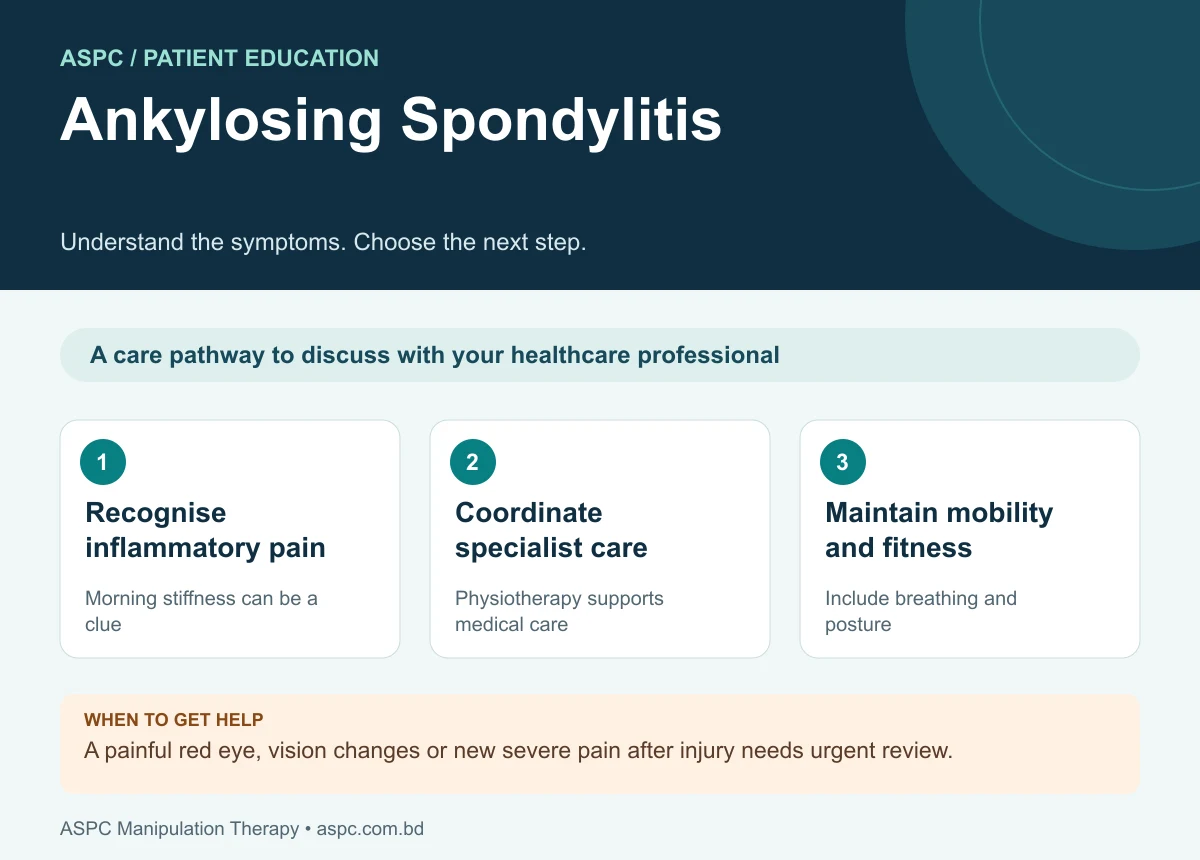
- Recognise inflammatory pain: Morning stiffness can be a clue.
- Coordinate specialist care: Physiotherapy supports medical care.
- Maintain mobility and fitness: Include breathing and posture.
Ankylosing spondylitis (AS) is a chronic inflammatory form of axial spondyloarthritis that primarily affects the sacroiliac joints and spine. It can cause persistent back pain, morning stiffness and reduced spinal mobility, often beginning in late adolescence or early adulthood. Symptoms may interfere with sleep, work, exercise and everyday activities.
Although AS has no established cure, early recognition, appropriate medical treatment and regular individualized exercise can help control inflammation, maintain function and reduce the impact of complications. Management usually involves coordinated care from rheumatology and physiotherapy professionals.
What Is Ankylosing Spondylitis?
Ankylosing spondylitis is a long-term immune-mediated inflammatory disease within the axial spondyloarthritis family. Inflammation commonly involves the sacroiliac joints, vertebral structures and entheses—the sites where tendons or ligaments attach to bone. In some people, repeated inflammation and repair can lead to new bone formation, reduced spinal flexibility and, in advanced disease, partial fusion of vertebrae.
The disease is not simply age-related “wear and tear.” It is associated with genetic susceptibility, including HLA-B27, but this gene alone does not establish the diagnosis. Some people have axial spondyloarthritis without definite changes on plain X-rays; therefore, clinical assessment and, when indicated, MRI are important. A negative HLA-B27 test or normal inflammatory markers do not by themselves exclude the disease.
Causes and Risk Factors
The exact cause is not fully understood. Current evidence suggests that genetic susceptibility interacts with immune pathways and environmental factors. AS is multifactorial; having a risk factor does not mean a person will inevitably develop the disease.
Genetic susceptibility: HLA-B27 is strongly associated with AS, although its prevalence and predictive value vary among populations. Other genetic factors also contribute, and HLA-B27 testing must be interpreted alongside symptoms and examination findings.
Family history: Having a close relative with AS or another spondyloarthritis increases the likelihood of disease, but inheritance is not deterministic.
Immune-mediated inflammation: Inflammatory pathways, including tumour necrosis factor and interleukin-17, contribute to disease activity and are targets of some specialist medicines.
Age and sex: Symptoms commonly begin in late adolescence or early adulthood. The condition affects people of all sexes, and less typical presentation can contribute to delayed recognition.
Smoking and general health: Smoking is discouraged because it is associated with poorer health and may be linked to worse disease outcomes. Maintaining physical activity and addressing cardiovascular risk are important parts of long-term care.
Not everyone with these factors develops AS, and symptoms can overlap with mechanical back pain. Persistent inflammatory-pattern back pain, especially when accompanied by other spondyloarthritis features, warrants clinical assessment.
Symptoms and Pain Location
Symptoms vary between individuals and can fluctuate over time. Common features include:
Inflammatory back pain: gradual-onset pain lasting for months, often worse at night or after rest and improved by movement or exercise.
Morning stiffness: stiffness in the lower back or hips after waking that may ease as the person moves.
Reduced spinal mobility: difficulty bending, turning the trunk or maintaining an upright posture as the disease progresses.
Buttock or hip pain: pain may alternate between buttocks and can reflect sacroiliac joint involvement.
Fatigue: ongoing inflammation, disturbed sleep and reduced activity can contribute to tiredness.
Other manifestations: some people develop heel or other enthesis pain, peripheral arthritis, psoriasis, inflammatory bowel disease or acute anterior uveitis (painful red eye with light sensitivity).
Seek urgent medical assessment for a painful red eye with blurred vision or light sensitivity, because acute anterior uveitis requires prompt treatment. New severe spinal pain after even minor trauma in a person with advanced AS may indicate a fracture and needs urgent evaluation.
Disease Course and Recovery
AS does not follow one predictable sequence or timetable. Symptoms may wax and wane, and some people have limited structural progression while others develop substantial stiffness or spinal fusion. Treatment aims to reduce pain and inflammation, preserve mobility, support participation in daily life and prevent avoidable complications rather than promise a cure.
Early or active disease: pain, stiffness and fatigue may fluctuate. Early diagnosis and appropriate anti-inflammatory treatment can help control symptoms and support activity.
Persistent or established disease: some people experience continuing stiffness, reduced spinal range and limitations in daily activities; regular exercise and monitoring remain important.
Advanced structural change: spinal fusion or osteoporosis can increase vulnerability to spinal fracture. High-velocity spinal manipulation should be avoided in people with advanced fusion or significant osteoporosis.
Outcomes depend on disease activity, structural changes, associated conditions, treatment response and participation in an individualized exercise programme. Review by a rheumatology team is important when symptoms remain active or function declines.
Clinical assessment and rehabilitation

What the assessment includes
A structured musculoskeletal assessment can document the patient’s history, movement, muscle function and activity limitations. For suspected AS, it must be combined with appropriate medical evaluation because inflammatory disease cannot be confirmed by a mechanical examination alone.
History and symptom pattern: ask about duration and onset of back pain, morning stiffness, night pain, response to movement, family history, psoriasis, bowel symptoms and previous painful red-eye episodes.
Mobility and function: assess spinal movement, posture, hip mobility, chest expansion where appropriate, walking and relevant daily activities using standardized measures when available.
Medical coordination and differential diagnosis: refer for rheumatology assessment where inflammatory back pain is suspected. Imaging, inflammatory markers and HLA-B27 testing are interpreted in the overall clinical context; normal results do not automatically exclude disease.
How assessment guides management
Individualized exercise: physiotherapy should include spinal mobility, stretching, strengthening, postural work, deep breathing and aerobic exercise, tailored to symptoms and ability.
Manual therapy and safety: gentle adjunctive techniques may be considered by a suitably qualified clinician for selected symptoms, but they do not treat the underlying systemic inflammation. Avoid forceful spinal manipulation when spinal fusion, osteoporosis or fracture risk is present.
Medical treatment: a rheumatologist may recommend NSAIDs and, when disease remains active despite appropriate treatment, biologic or targeted synthetic medicines. Medication choice requires assessment of benefits, risks and associated conditions.
Reassessment: monitor pain, stiffness, mobility, function, exercise tolerance and treatment response; review the plan when disease activity or functional status changes.
Nutrition and Daily Tips
No specific diet has been shown to cure AS. A balanced dietary pattern, adequate protein, fruits and vegetables, and appropriate calcium and vitamin D intake can support general health and bone health. Individual needs should be discussed with a healthcare professional, particularly where osteoporosis risk, inflammatory bowel disease or medication-related concerns are present.
Keep moving: break up long periods of sitting and follow a sustainable daily mobility and exercise routine.
Practice posture and breathing exercises: use a physiotherapist-guided programme to maintain spinal extension, chest expansion and comfortable range of motion.
Avoid smoking: seek support to stop smoking and discuss cardiovascular risk factors during routine care.
Follow prescribed treatment: do not stop or change medication without consulting the prescribing clinician.
Protect the spine: avoid high-impact or risky activities if advanced spinal fusion or osteoporosis is present, and seek medical advice after trauma.
Other Conditions and When to Get Help
Mechanical back pain, disc disorders, hip disease and other inflammatory conditions can resemble AS. Assessment is important when back pain begins at a young age and persists, especially when it improves with exercise or is associated with night pain, morning stiffness, psoriasis, bowel inflammation or a family history of spondyloarthritis. Seek medical review if:
Persistent symptoms: back pain or stiffness continues for several weeks, repeatedly disturbs sleep or limits daily activity.
Worsening function: spinal movement, walking, work or self-care becomes increasingly difficult.
Possible uveitis: a painful red eye, light sensitivity or blurred vision requires urgent same-day assessment.
Possible spinal fracture: new severe spinal pain after trauma, especially with known spinal fusion or osteoporosis, needs urgent evaluation.
Neurological warning signs: new limb weakness, numbness around the groin, or loss of bladder or bowel control requires emergency assessment.
Final Takeaway
Ankylosing spondylitis is a chronic inflammatory disease that can cause back pain, morning stiffness and reduced spinal mobility, with effects that vary from person to person. Early diagnosis, appropriate rheumatology care, regular individualized exercise and ongoing monitoring help manage symptoms and preserve function. Physiotherapy should emphasize spinal mobility, posture, strengthening, chest expansion and aerobic fitness, while avoiding unsafe forceful techniques in people at risk of spinal fracture. If persistent inflammatory-pattern back pain, a painful red eye or sudden severe spinal pain occurs, seek appropriate medical assessment. The goal is to maintain movement, independence and quality of life through coordinated, evidence-based care.
Common questions
Can ankylosing spondylitis be cured?
There is no established cure, but medical treatment and regular individualized exercise can help control symptoms and preserve function.
Does physiotherapy replace rheumatology care?
No. Exercise supports mobility and function, while a rheumatologist evaluates inflammation and the need for medication.
Is forceful spinal manipulation appropriate?
It should be avoided where spinal fusion, osteoporosis or fracture risk makes it unsafe. Treatment needs an individual risk assessment.
Assessment and rehabilitation in Dhaka
ASPC Manipulation Therapy provides physiotherapy assessment and rehabilitation in Dhaka. An appointment can help clarify your symptoms, current movement and strength, daily activity goals and whether medical referral is needed. Care should be individualized, with progress reviewed rather than a guaranteed recovery promise.
ASPC describes its assessment framework as Structural Diagnosis and Management (SDM). A named framework does not establish effectiveness for every condition. Treatment choices should follow the clinical findings, relevant guidance and the person’s preferences.
Discuss an assessment with ASPC
Related patient guides
- PLID and Disc Prolapse: Herniated Disc Symptoms and Treatment
- Back and Low Back Pain: Causes, Exercises and Treatment
- Sciatica: Symptoms, Sleep, Exercises and Treatment
Sources and further reading
Read the condition-specific guidance below alongside the assessment and exercise information in this article. Guidelines inform general care; they do not establish individual outcomes or superiority of a clinic.
Editorial update: 26 October 2026. Medical information disclaimer.


