

The featured image and supporting patient illustrations are AI-generated and do not depict actual patients.
ASPC Patient Education · Updated 26 October 2026
At a glance
Urinary incontinence means unintentional urine leakage. Stress, urgency, mixed and overflow incontinence need different approaches. Assessment helps identify the type and whether pelvic floor training, bladder training or medical care is appropriate.
General patient information. Diagnosis and treatment should be individualized by a qualified healthcare professional.
Get help promptly: New bladder changes with back pain, saddle numbness or leg weakness: emergency assessment.
In this guide
- What Is Urinary Incontinence?
- How Common Is It? Prevalence and Epidemiology
- Causes and Risk Factors
- Symptoms and Leakage Pattern
- Is leaking urine a normal part of ageing?
- The Course of Symptoms and Recovery Time
- Assessment and Treatment: Structural Diagnosis and Management (SDM) at ASPC Manipulation Therapy
- Nutrition and Daily Tips
- Other Conditions and When to Get Help
- Final Takeaway
- Common questions
- References and clinical guidance
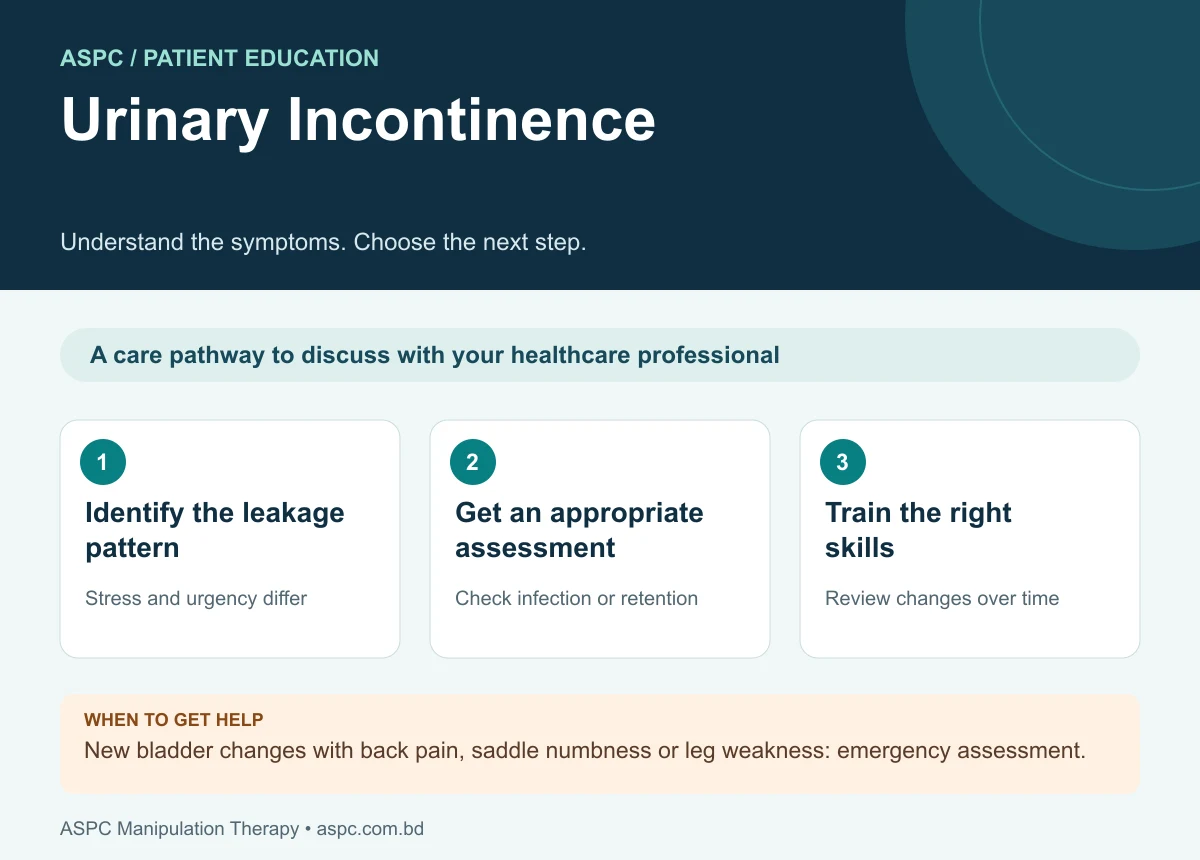
- Identify the leakage pattern: Stress and urgency differ.
- Get an appropriate assessment: Check infection or retention.
- Train the right skills: Review changes over time.
Urinary incontinence is the unintentional passing of urine. It may range from a few drops when coughing or laughing to a sudden, intense urge that cannot be controlled, or frequent leakage because the bladder does not empty fully. It can affect confidence, sleep, exercise, work and social life, and many people delay seeking help because the problem feels embarrassing. The pattern of leakage helps guide assessment, but it does not establish a diagnosis on its own (NICE guidance).

The featured image and supporting patient illustrations are AI-generated and do not depict actual patients.
Urinary incontinence may begin after childbirth, surgery, illness or a change in medicines, or it may develop gradually over time. It is common, and it is not an inevitable part of ageing. Many people improve with lifestyle changes, pelvic floor and bladder training, and other treatment matched to the type of leakage (NICE guidance). New leakage together with fever, blood in the urine, severe pain, inability to pass urine or new weakness or numbness requires prompt medical assessment. Effective care starts with identifying the likely type and cause and matching treatment to the person's symptoms, function and health needs (NICE guidance; Nambiar et al., 2022).
What Is Urinary Incontinence?
The bladder stores urine until it is convenient to empty it. Its wall contains the detrusor muscle, which relaxes to allow filling and contracts to empty the bladder. The urethra carries urine out of the body and is kept closed by the urethral sphincter and the supporting pelvic floor muscles. Nerves from the brain and spinal cord coordinate this system so that the bladder contracts and the sphincter relaxes only when a person chooses to pass urine (Aoki et al., 2017).
Urinary incontinence is a symptom rather than one specific disease. The International Continence Society defines it as the complaint of involuntary loss of urine . Stress incontinence is leakage when the bladder is under pressure, for example when coughing or laughing; urge (urgency) incontinence is leakage with a sudden, intense urge to pass urine; mixed incontinence combines both; overflow incontinence occurs when the bladder cannot empty fully; and total incontinence describes a bladder that cannot store urine at all . These patterns overlap, so assessment is needed to distinguish the likely type and cause (NICE guidance).
How Common Is It? Prevalence and Epidemiology
Urinary incontinence occurs across age groups, but its type and likely causes vary with age, sex, pregnancy and childbirth history, general health and other factors. Published estimates vary widely because studies use different definitions, questionnaires and populations. A review of studies in adult women reported a range of about 5–72% for incontinence of any type, with many studies converging on a prevalence near 30%; age-specific incidence was below 2 per 1,000 person-years in women under 40 years but rose with increasing age (Aoki et al., 2017). The NHS notes that incontinence becomes more common in middle age and is very common in people over 80 years, although it is not an inevitable part of ageing .Rather than assuming that all leakage is the same problem, clinicians consider the person's age, the circumstances in which leakage occurs, bladder habits, medical history and associated symptoms. The following table summarizes common clinical categories; it is a clinical overview, not a ranking of prevalence (NICE guidance).
| Clinical category | Typical clues (not diagnostic on their own) |
|---|---|
| Stress incontinence | Leakage when the bladder is under pressure, such as coughing, laughing, sneezing, lifting or exercise. |
| Urgency incontinence | A sudden, intense urge to pass urine, with leakage during the urge or soon afterwards. |
| Mixed incontinence | Features of both stress and urgency leakage in the same person. |
| Overflow incontinence | Frequent small trickles of urine, a weak or interrupted stream and a feeling that the bladder never empties fully. |
| Total incontinence | Constant or very frequent leakage, even at night; may relate to a bladder problem from birth, spinal injury or fistula and needs specialist assessment. |
Causes and Risk Factors
Urinary incontinence can result from weakness of the pelvic floor or urethral sphincter, overactivity of the bladder muscle, incomplete bladder emptying, nerve disorders, infection, medicines or a combination of factors. The cause cannot always be identified from the pattern of leakage alone (NICE guidance).
- Pelvic floor and sphincter weakness (stress incontinence): weakening of or damage to the pelvic floor muscles and urethral sphincter is the usual mechanism. Pregnancy and vaginal birth, increased pressure on the abdomen such as obesity, and surgery to nearby structures such as hysterectomy or prostate removal may contribute .
- Bladder muscle overactivity (urge incontinence): usually results from overactivity of the detrusor muscle. Alcohol, caffeine, constipation, not drinking enough fluid and conditions of the lower urinary tract such as infection may contribute .
- Obstruction and incomplete emptying (overflow incontinence): often caused by an obstruction or blockage that prevents the bladder from emptying fully, leading to frequent leakage .
- Neurological conditions: disorders affecting the brain and spinal cord, such as Parkinson's disease or multiple sclerosis, and spinal injury can disturb bladder control .
- Age, family history and weight: increasing age, a family history of incontinence and obesity can increase the chance of incontinence, although it is not an inevitable part of ageing .
- Medicines and connective tissue conditions: certain medicines and some connective tissue disorders, such as Ehlers-Danlos syndrome, may contribute to leakage .
- Structural causes of total incontinence: a bladder problem present from birth, a spinal injury or a fistula between the bladder and a nearby area can prevent the bladder from storing urine .
Having a risk factor does not mean a person will develop urinary incontinence, and the same symptom can arise from different conditions. Persistent, worsening or function-limiting leakage deserves assessment rather than self-diagnosis.
Symptoms and Leakage Pattern
The type, timing and triggers of leakage provide useful clues. Consider professional assessment if you notice (NICE guidance):
- Leakage when coughing, laughing, sneezing, lifting or exercising
- A sudden, intense urge to pass urine, with leakage before reaching the toilet
- Needing to pass urine very frequently, or waking at night to pass urine
- Small trickles of urine, a weak or interrupted stream, or a feeling that the bladder never empties fully
- Constant or very frequent leakage, including at night
- Limiting fluids, avoiding exercise or outings, or relying on pads because of fear of leaking
Leakage with coughing or laughing points toward stress incontinence, whereas leakage after a sudden strong urge points toward urgency incontinence; many people have features of both. These patterns are only clues. A clinical consultation considers them together with a diary of fluid intake and toilet visits, examination and medical history (NICE guidance).
Urgent warning signs: Seek urgent medical care if you suddenly cannot pass urine, or if leakage occurs with fever, blood in the urine, severe pelvic or back pain, new leg weakness, numbness around the genitals or buttocks, or loss of bowel control. These features are not typical of simple stress or urgency leakage; do not try to treat them with exercise or manipulation.
Is leaking urine a normal part of ageing?
No. Incontinence becomes more common with age, but it is not an inevitable part of ageing, and many people can be helped by assessment and treatment (NICE guidance).
The Course of Symptoms and Recovery Time
- Temporary incontinence: leakage linked to a treatable cause, such as infection, constipation or caffeine and alcohol intake, may improve when the cause is addressed .
- Persistent stress or urgency incontinence: symptoms may continue when pelvic floor support, bladder control or nerve control remains impaired. A structured plan of training, lifestyle change and, when needed, medical treatment can reduce leakage (NICE guidance; Nambiar et al., 2022).
- Incontinence after pregnancy, childbirth or pelvic surgery: symptoms that begin after childbirth, hysterectomy or prostate surgery should be assessed rather than assumed to settle on their own. Pelvic floor exercises during pregnancy may help prevent incontinence .
There is no single recovery timeline. A Cochrane review of 31 trials involving 1,817 women supported pelvic floor muscle training compared with inactive control. The stress-incontinence improvement-or-cure estimate of 74% versus 11% came from a smaller subgroup of 3 trials involving 242 women; it is not a success rate for every type of leakage. For women with stress or mixed incontinence, NICE recommends supervised pelvic floor muscle training for at least 3 months; urgency or mixed symptoms may be offered bladder training for at least 6 weeks (Dumoulin et al., 2018; NICE guidance).
Assessment and Treatment: Structural Diagnosis and Management (SDM) at ASPC Manipulation Therapy
Treatment begins with assessment of the likely diagnosis, functional limitations and warning signs. ASPC describes Structural Diagnosis and Management (SDM) as its assessment framework, linking history, physical and neurological examination where relevant, and an individualized management plan. The condition-specific assessment and rehabilitation details follow below.
How SDM assesses urinary leakage
Published descriptions of SDM describe a systematic musculoskeletal assessment that includes history, joint movement, muscle length and strength, regional biomechanics and neurological examination. For urinary incontinence, these elements should be used alongside established continence assessment and appropriate red-flag screening (Haque et al., 2020; NICE guidance).
- History and symptom behaviour: establish the type, triggers, frequency and amount of leakage, night-time symptoms, fluid, caffeine and alcohol intake, bowel habit, medicines, childbirth and surgical history, and the effect on daily life. A diary of fluid intake and toilet visits is often helpful (NICE guidance).
- Structural and functional examination: assess posture, lumbopelvic and hip movement, muscle length and strength, mobility and the ability to reach the toilet safely, with neurological screening when indicated. Examination of the pelvic floor, when needed, should be explained and carried out with consent by a suitably trained clinician (NICE guidance).
- Differential diagnosis and referral: consider stress, urgency, mixed and overflow incontinence, infection, neurological causes and medicine effects. Medical review, urine testing, urodynamic assessment or specialist referral is arranged when indicated; urgent red flags take priority over manual treatment (NICE guidance; Nambiar et al., 2022).
How SDM may guide management
- Diagnosis-led plan: Treatment should be selected from the assessment findings, the person's goals and the likely type of incontinence rather than using one fixed protocol for every patient (NICE guidance).
- Pelvic floor muscle training: For stress or mixed incontinence, guidelines support supervised pelvic floor muscle training as first-line care, and a Cochrane review found that it improved or cured symptoms more often than no treatment (NICE guidance; Nambiar et al., 2022; Dumoulin et al., 2018).
- Bladder training and lifestyle measures: Bladder training teaches ways to wait longer between toilet visits and is recommended for urgency or mixed incontinence. Cutting down on caffeine and alcohol, maintaining a healthy weight and keeping sensible fluid intake may also help (NICE guidance).
- Manual therapy: Hands-on techniques may be considered as an adjunct for selected patients, for example when lumbopelvic or hip stiffness or muscle tightness is found, but they should not replace pelvic floor training, bladder training or appropriate medical care. The sources cited here do not establish that manual therapy treats incontinence itself, and techniques should be modified or avoided when infection, neurological red flags or another contraindication is suspected (NICE guidance).
- Regular reassessment: Monitor leakage episodes, pad use, night-time symptoms, diary findings and personally important activities. The plan should change if symptoms worsen or progress is not as expected (NICE guidance).
- Medical and surgical options when needed: A GP or specialist may consider medicines or other treatments if symptoms remain, and surgery may be considered; suitable procedures depend on the type of incontinence. NICE guidance places restrictions on some mesh procedures, so options should be discussed with a specialist team (NICE guidance).
An honest note on the evidence: SDM is a clinician-developed framework, and the cited original description concerns lumbar spine assessment. A randomized clinical trial has evaluated SDM in plantar heel pain, but that does not establish effectiveness for urinary incontinence. No incontinence-specific randomized trial of SDM is cited here; therefore, SDM-based care should be regarded as an institutional approach rather than an independently proven treatment for urinary incontinence (Haque et al., 2020; Akter et al., 2024).
Nutrition and Daily Tips
No specific food cures urinary incontinence. A balanced diet with vegetables, fruit, whole grains and adequate fluids supports general health, and avoiding constipation is helpful because constipation can contribute to bladder overactivity . For people who are overweight, maintaining a healthy weight may lower the risk of incontinence . Cutting down on caffeine and alcohol, which can increase urine production and irritate the bladder, may help . Drinking too little can make symptoms worse: the NHS advises about 6 to 8 glasses of fluid a day unless a doctor advises otherwise, because limiting fluids reduces bladder capacity and can worsen constipation . If you wake often at night to pass urine, drinking a little less in the hours before bed may help, while still drinking enough during the day .
Stay active and keep doing the pelvic floor and bladder exercises that a clinician has taught you rather than relying on pads alone. Keep a diary of fluids and toilet visits if advised, avoid straining with constipation and return to exercise gradually. Absorbent pads and other products can help while treatment is under way, but they do not replace assessment . Do not restrict fluids as a way of avoiding leaks.
Other Conditions and When to Get Help
Not every episode of leakage is caused by a weak pelvic floor. Urinary tract infection, constipation, an obstructed bladder outlet, neurological disease, medicines, pelvic organ prolapse and problems present from birth can produce overlapping symptoms. See a GP or physiotherapist if (NICE guidance):
- Leakage persists, worsens or keeps returning
- Leakage affects sleep, work, exercise, relationships or normal daily activities
- You limit fluids, avoid outings or rely on pads because of leakage
- Leakage began after childbirth, pelvic surgery or a change in medicines
- You have a weak stream, frequent small leaks or a feeling that the bladder never empties
- You develop new weakness, numbness or loss of bowel control — urgent assessment is needed
- You have fever, blood in the urine or severe pain, or you suddenly cannot pass urine — seek urgent care
Agrani Specialized Physiotherapy Centre (ASPC) describes its services as including physiotherapy and musculoskeletal assessment, with management organized around Structural Diagnosis and Management (SDM). The center's published descriptions are institutional information and should not be treated as independent evidence of treatment outcomes.
Final Takeaway
Urinary incontinence is a symptom with several possible types and causes, from pelvic floor weakness and bladder overactivity to incomplete emptying and nerve disorders. The pattern of leakage can guide assessment, but it cannot confirm a diagnosis by itself. A careful examination, recognition of urgent warning signs and a management plan matched to the person's type of incontinence are central to safe recovery. Pelvic floor and bladder training, lifestyle change and education are important first-line components of care for many people, while medicines, devices or surgery may be needed for selected conditions. SDM is one clinician-developed assessment framework, but incontinence-specific evidence for its effectiveness is not established. Seek professional assessment when leakage persists, worsens or interferes with normal life, and seek urgent care for inability to pass urine, fever, blood in the urine, severe pain or new neurological symptoms (NICE guidance; Nambiar et al., 2022).
Common questions
Is leakage a normal part of ageing?
It is common but should not simply be accepted without assessment. Several causes are treatable and the right approach depends on the type of leakage.
Should everyone do pelvic floor exercises?
Pelvic floor training helps some types of incontinence, but correct contraction and relaxation matter. Pain, poor emptying or an overactive pelvic floor may require a different approach.
Is overactive bladder the same as incontinence?
No. Overactive bladder involves urgency, often with frequency and nighttime urination, and can occur with or without leakage.
Assessment and rehabilitation in Dhaka
ASPC Manipulation Therapy provides physiotherapy assessment and rehabilitation in Dhaka. An appointment can help clarify your symptoms, current movement and strength, daily activity goals and whether medical referral is needed. Care should be individualized, with progress reviewed rather than a guaranteed recovery promise.
ASPC describes its assessment framework as Structural Diagnosis and Management (SDM). A named framework does not establish effectiveness for every condition. Treatment choices should follow the clinical findings, relevant guidance and the person’s preferences.
Discuss an assessment with ASPC
Related patient guides
- Foot Drop: Causes, Warning Signs and Rehabilitation
- Diabetic Neuropathy: Symptoms, Foot Care and Rehabilitation
- Proximal Neuropathy: Hip and Thigh Weakness, Diagnosis and Care
Related assessment and rehabilitation guides
References and clinical guidance
Guidelines inform general care; studies have specific populations and limitations. The SDM framework description and plantar-heel-pain trial should be read in their own clinical context.
- NHS condition-specific patient guidance
- Akter, Hossain, Hossain et al. (2024). Comparison of Structural Diagnosis and Management (SDM) approach and MyoFascial Release (MFR) for improving plantar heel pain, ankle range of motion and disability: A randomized clinical trial. Journal of Manual & Manipulative Therapy.
- Aoki, Brown, Brubaker et al. (2017). Urinary incontinence in women. Nature Reviews Disease Primers.
- Bo, Frawley, Haylen et al. (2016). An International Urogynecological Association (IUGA)/International Continence Society (ICS) joint report on the terminology for the conservative and nonpharmacological management of female pelvic floor dysfunction. International Urogynecology Journal.
- Dumoulin, Cacciari, Hay-Smith (2018). Pelvic floor muscle training versus no treatment, or inactive control treatments, for urinary incontinence in women. Cochrane Database of Systematic Reviews.
- Haque (2020). Treating Mechanical Dysfunctions of Lower Back through Lumbar Spine Assessment of Structural Diagnosis and Management (SDM): A New Comprehensive Approach of Musculoskeletal Medicine. American Journal of Biomedical Science & Research.
- Nambiar, Arlandis, Bø et al. (2022). European Association of Urology Guidelines on the Diagnosis and Management of Female Non-neurogenic Lower Urinary Tract Symptoms. Part 1: Diagnostics, Overactive Bladder, Stress Urinary Incontinence, and Mixed Urinary Incontinence. European Urology.
- NICE NG123: urinary incontinence management in women
- Cochrane: pelvic floor muscle training compared with inactive control
Content restored and references checked: 26 October 2026. This editorial check does not replace individual clinical assessment. Medical information disclaimer.