

ASPC PATIENT EDUCATION · UPDATED 29 OCTOBER 2026
At a glance
Sports physiotherapy combines injury assessment, rehabilitation, progressive exercise and preparation for return to sport. Readiness depends on healing, symptoms, physical capacity and sport-specific demands.
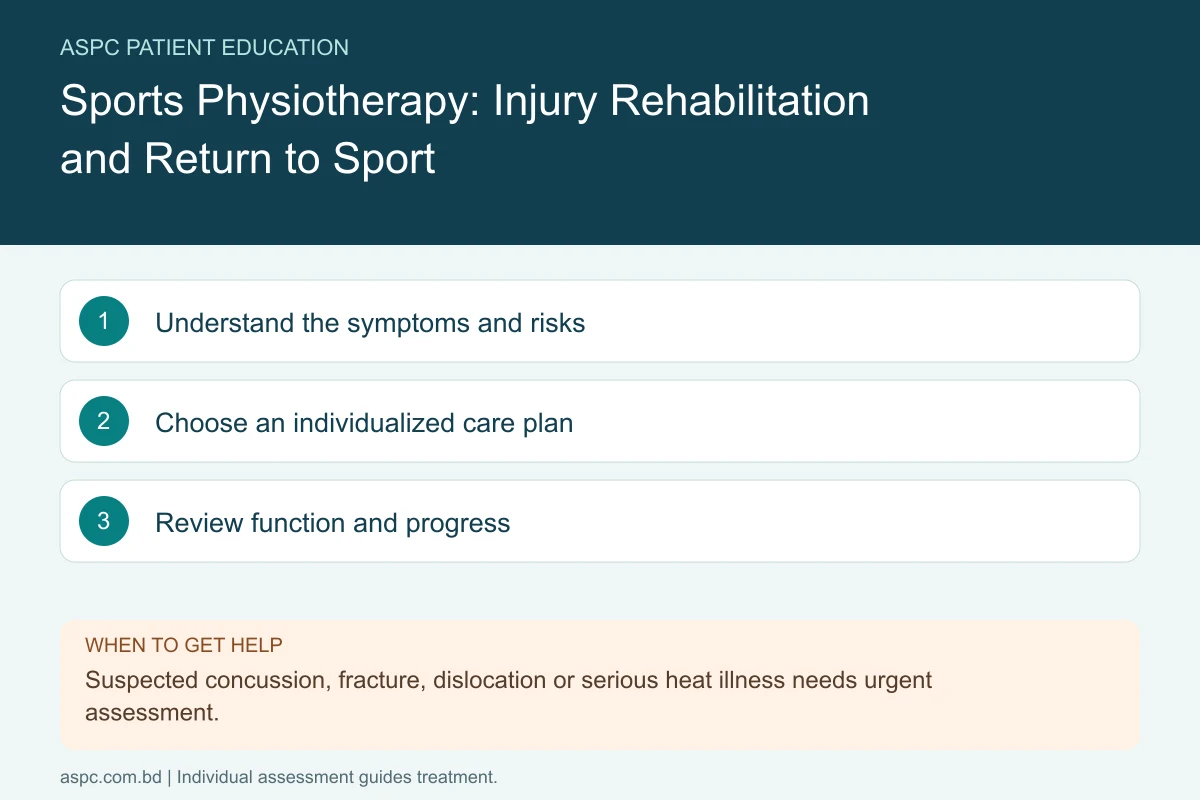
When to get help: Suspected concussion, fracture, dislocation or serious heat illness needs urgent assessment.
The featured image is AI-generated and does not depict an actual patient. General information; care should follow an individual assessment.
In this guide
- What Is Sports Physiotherapy?
- How Common Are Sports Injuries? Epidemiology
- Causes and Risk Factors
- Symptoms and Injury Presentation
- Common Injury Patterns and Recovery
- Assessment and Treatment: Evidence-Based Sports Physiotherapy
- Injury Prevention: Practical Strategies
- Return to Sport: Criteria and Recovery Progression
- Nutrition and Daily Tips
- Other Conditions and When to Get Help
- Sports Physiotherapy Services and Professional Care
- Final Takeaway
- Common questions
- References
Sports physiotherapy is a specialised area of physiotherapy concerned with the health, physical function and performance of people participating in sport and exercise. It includes injury prevention, early assessment, rehabilitation and support for a safe return to training and competition. Athletes may experience acute injuries, such as ligament sprains and muscle strains, as well as gradual-onset problems related to repetitive loading (Herring et al., 2024; Schmitt et al., 2016).
Effective care is individualised: the clinician considers the athlete’s sport, position, training history, physical capacity, goals and the demands of competition. Rehabilitation should restore symptoms and function while progressively preparing the athlete for sport-specific tasks. Return to sport is a continuum rather than a single clearance date, and decisions are best made collaboratively by the athlete and relevant health and performance professionals (Ardern et al., 2016).
What Is Sports Physiotherapy?
Sports physiotherapy applies evidence-informed physiotherapy assessment and treatment to athletes and physically active people across recreational, school, university and elite levels. Its purpose is not limited to treating injury; it also supports physical preparation, load management, movement quality and strategies that may reduce injury risk. A sports physiotherapist may work alongside sports physicians, coaches, strength and conditioning staff, nutrition professionals and psychologists, while maintaining clear professional responsibilities and referral pathways (Herring et al., 2024).
Sports injuries can affect muscles, tendons, ligaments, bones, joints and the nervous system. Their presentation depends on the tissue involved, the mechanism of injury, the athlete’s previous history and the sport-specific demands. A diagnosis should therefore be based on a structured history and examination rather than symptoms or a single screening test alone (Herring et al., 2024).
How Common Are Sports Injuries? Epidemiology
Sports injuries occur in training and competition, but reported rates vary substantially according to sport, age, sex, exposure time, competition level and the definition used for an injury. Contact sports may involve collision-related injuries, while running, jumping and overhead sports can produce injuries associated with repetitive loading. Injury surveillance should ideally record both the number of injuries and the amount of athlete exposure, allowing comparisons to be interpreted more carefully (Herring et al., 2024).
A single prevalence figure cannot represent all athletes. In addition, an injury that causes time away from sport is not the same as a symptom that limits performance but does not stop participation. Clinicians and sporting organisations should interpret statistics within the specific sport and population studied and avoid treating estimates from one sport as universal rates (Ardern et al., 2016).
| Sport or exposure pattern | Examples of common injury concerns |
|---|---|
| Running and endurance sports | Gradual-onset tendon pain, bone stress injury, muscle overload |
| Football, basketball and court sports | Ankle sprain, knee ligament injury, muscle strain, collision injury |
| Racket, throwing and overhead sports | Shoulder and elbow overuse problems, muscle-tendon pain |
| Contact and combat sports | Contusions, sprains, fractures and concussion risk |
| Gymnastics and jumping sports | Landing-related injuries, wrist/ankle problems and bone stress injury |
Table 1. Illustrative injury concerns by sport or exposure pattern. These examples are not prevalence estimates and do not predict an individual athlete’s diagnosis.
Causes and Risk Factors
Sports injuries are usually multifactorial. An injury may occur after a sudden external force or during a movement that exceeds the current capacity of a tissue. Gradual-onset injuries may develop when training load, recovery and tissue capacity are not well matched. Risk factors should be interpreted as contributors rather than guarantees that an athlete will be injured (Herring et al., 2024).
- Training load and recovery: rapid or poorly tolerated changes in training volume, intensity, frequency or competition exposure can contribute to overload. Load should be adjusted to the athlete’s response, recent training and recovery.
- Previous injury: a history of injury can be associated with recurrence, particularly when strength, movement confidence or sport-specific capacity has not been fully restored.
- Strength, power and movement control: deficits in strength, balance, landing mechanics or change-of-direction control may be relevant to particular injuries and sports.
- Technique and equipment: sport-specific technique, footwear, protective equipment and playing surface may influence loading or injury mechanisms; their relevance differs by injury type.
- Physical and psychological factors: sleep, fatigue, nutrition, stress, confidence, and pressure to continue playing can influence recovery and decisions about training or return to sport.
- Environment and sport context: weather, surface conditions, contact rules, scheduling and access to qualified medical support can alter injury exposure and management.
No single screening measure reliably predicts every future injury. Prevention is more effective when it combines appropriate training, sport-specific conditioning, education, sensible load progression and an environment that supports early reporting of symptoms (Crossley et al., 2025).
Symptoms and Injury Presentation
Symptoms depend on the tissue and mechanism involved. Athletes may report pain, swelling, bruising, reduced range of motion, weakness, instability, altered running or jumping mechanics, or a decline in performance. Some overuse conditions begin gradually, whereas fractures, dislocations and significant ligament injuries may follow a clear event (Herring et al., 2024).
- Acute pain or swelling: may follow a twist, collision, fall or sudden acceleration and warrants assessment when severe or associated with functional loss.
- Loss of function: difficulty bearing weight, sprinting, jumping, gripping or moving a joint can indicate that training should be modified until the problem is assessed.
- Recurring or progressive symptoms: pain that repeatedly returns during activity, increases over successive sessions or persists at rest may indicate that current loading exceeds capacity.
- Neurological or systemic warning signs: numbness, progressive weakness, deformity, severe pain, or symptoms suggesting a serious head, neck or spinal injury require urgent medical evaluation.
Possible concussion requires immediate removal from play and appropriate medical assessment; an athlete should not return to the same session while concussion is suspected. Emergency care is also required for suspected fracture or dislocation, major bleeding, heat illness with altered mental status, or rapidly worsening symptoms. These warning signs should not be managed by exercise alone (Herring et al., 2024).
Common Injury Patterns and Recovery
Recovery time varies substantially. A mild muscle strain and a surgically reconstructed ligament have different tissue-healing demands and functional milestones. Time since injury is useful information, but it should not be the sole basis for progression. The clinician should consider symptoms, range of motion, strength, power, balance, sport-specific performance, confidence and response to increased training load (Ardern et al., 2016).
- Muscle strains: management commonly progresses from symptom-guided loading and restoration of movement to strengthening, running or sport-specific speed and repeated high-intensity tasks.
- Ligament sprains: rehabilitation may include swelling and pain management, mobility, strength, balance, neuromuscular control and progressively challenging cutting or landing tasks.
- Tendon-related pain: load modification and progressive strengthening are commonly central, with loading adjusted to the tendon’s response and the athlete’s sport demands.
- Bone stress injuries: require careful clinical assessment and management of loading, contributing factors and nutrition; returning too early can worsen the injury.
- Concussion: requires clinician-led assessment and a graduated return-to-learn and return-to-sport process, with medical clearance as required by applicable guidance.
Assessment and Treatment: Evidence-Based Sports Physiotherapy
Sports physiotherapy begins with a clear assessment and a plan linked to the athlete’s goals and the demands of their sport. The approach should be evidence-informed, measurable and reviewed regularly. Manual therapy or other symptom-modifying techniques may sometimes be used as adjuncts, but they should not replace active rehabilitation, progressive loading or sport-specific preparation when these are indicated (Herring et al., 2024).
How a sports physiotherapist assesses an athlete
A comprehensive assessment typically combines the athlete’s account of the problem with observation, physical examination and relevant functional testing. The clinician should also identify conditions that need referral to a physician or emergency service.
- History and sport demands: document the mechanism and timing of symptoms, training and competition load, previous injuries, medical history, goals, position or event, and the movements required for participation.
- Physical examination: assess pain, swelling, range of motion, strength, power, balance, coordination and relevant neurological or vascular signs, selecting tests appropriate to the suspected injury.
- Functional testing: use appropriate tasks such as hopping, landing, sprinting, change of direction, throwing or sport-specific drills when safe and clinically relevant.
- Differential diagnosis and referral: consider alternative explanations and refer for medical assessment or imaging when indicated by the history, examination or red flags.
- Baseline measures and review: record meaningful outcomes so changes can be tracked and the rehabilitation plan adjusted.
How physiotherapy guides management
- Individualised plan: treatment targets the identified impairment and the athlete’s goals rather than applying the same protocol to every injury.
- Progressive exercise: mobility, strength, power, balance, coordination and conditioning are introduced or progressed according to tissue tolerance and functional goals.
- Load modification: training may be reduced, adapted or temporarily paused while the athlete maintains safe, appropriate activity where possible.
- Education and self-management: the athlete learns about expected symptoms, recovery, sleep, recovery strategies, adherence and signs that require reassessment.
- Team communication: with appropriate consent, the clinician coordinates with the athlete, physician, coach and performance staff to align rehabilitation and training demands.
- Regular reassessment: symptoms, function and response to training are reviewed; progression is changed if symptoms worsen or expected milestones are not met.
Injury Prevention: Practical Strategies
Injury prevention is best approached as an ongoing part of training rather than a single warm-up or screening session. Exercise-based programmes that combine neuromuscular training, strength, balance, movement control and sport-specific preparation can reduce the risk of some injuries, although effects vary by sport and injury outcome (Crossley et al., 2025).
- Structured warm-up: use a progressive warm-up that prepares the athlete for the speed, movement and decision-making demands of the session.
- Strength and neuromuscular training: include suitable lower- and upper-limb strength, trunk control, balance, landing and change-of-direction tasks.
- Progressive training load: increase training demands in a planned manner and monitor pain, fatigue, performance and recovery.
- Technique and skills: teach and practise safe landing, deceleration, cutting, tackling or throwing technique as appropriate to the sport.
- Recovery and health: support adequate sleep, hydration, nutrition and recovery between demanding sessions; persistent fatigue or recurrent pain should be reviewed.
- Early reporting: encourage athletes to report symptoms promptly and avoid pressure to continue when serious injury is suspected.
Prevention programmes should be implemented consistently and evaluated using injury records, participation exposure and athlete feedback. A programme that works in one sport or population may require adaptation before being applied elsewhere (Crossley et al., 2025).
Return to Sport: Criteria and Recovery Progression
Return to sport is a staged process. Return to participation means the athlete resumes some modified training or activity but is not yet at the target level. Return to sport means the athlete has resumed the defined sport, while return to performance means performance has returned to the desired preinjury or target level. These stages may overlap with rehabilitation and should be reviewed as the athlete’s response changes (Ardern et al., 2016).
- Symptoms and clinical status: pain, swelling, range of motion and relevant clinical findings should be compatible with the planned activity.
- Physical capacity: strength, power, endurance, balance and functional performance should be appropriate to the injury and sport.
- Sport-specific demands: the athlete should progressively tolerate the actual speed, intensity, contact, decision-making and repeated-effort demands required.
- Psychological readiness: confidence, fear of reinjury and the athlete’s perception of readiness should be discussed alongside physical measures.
- Shared decision-making: the athlete and relevant clinicians and sporting staff should agree on goals, restrictions, monitoring and the plan for progression.
No universal test battery or calendar date guarantees safe return for every injury. A decision should integrate the best available evidence, examination findings, sport context and the consequences of reinjury. If symptoms recur or performance deteriorates, progression may need to pause or move back to a previous stage (Ardern et al., 2016).
Nutrition and Daily Tips
Adequate energy, protein, carbohydrate, fluids and a varied diet support training adaptation and recovery. Nutritional needs differ with sport, body size, training load, climate and injury type. Athletes with suspected low energy availability, recurrent bone stress injury, significant weight change or disordered eating concerns should be referred to qualified healthcare and nutrition professionals. Supplements should not replace a balanced diet or be used without considering safety and anti-doping rules.
Athletes should follow the agreed home programme, monitor symptoms and fatigue, maintain sleep routines and communicate changes to the clinical team. Avoid using pain relief simply to mask symptoms and continue high-intensity training without advice. Medication decisions, concussion management and significant injuries require appropriate medical input.
Other Conditions and When to Get Help
Not every sports-related pain is a simple strain or sprain. Fractures, dislocations, tendon ruptures, significant ligament injuries, nerve or vascular injuries and medical conditions can initially resemble less serious problems. Seek urgent medical care for:
- Suspected fracture or dislocation: deformity, severe pain, inability to use the limb or inability to bear weight after trauma.
- Possible concussion or spinal injury: confusion, loss of consciousness, repeated vomiting, worsening headache, neck pain with neurological symptoms, or altered behaviour.
- Circulation or nerve symptoms: a cold or pale limb, new numbness, progressive weakness or loss of sensation.
- Severe systemic symptoms: collapse, confusion, breathing difficulty, or suspected exertional heat stroke.
- Persistent or worsening symptoms: pain that does not improve, repeated injury, night or rest pain, or a progressive decline in function.
When in doubt, stop the activity and seek assessment from a qualified healthcare professional. Early, appropriate assessment can help identify injuries that need urgent treatment and guide a safer rehabilitation plan.
Sports Physiotherapy Services and Professional Care
A suitable sports physiotherapy service should offer a clear assessment, a working diagnosis or explanation of the problem, measurable goals, an individualised rehabilitation plan and regular reassessment. The clinician should explain the expected benefits and limitations of proposed treatments and refer to a physician or other specialist when needed.
Athletes should look for clinicians with appropriate registration, relevant sports-injury experience, safe emergency and referral procedures, and a willingness to coordinate with the athlete’s wider care team. Claims of guaranteed recovery or universal return-to-play timelines should be treated cautiously. Treatment quality is better judged by transparent clinical reasoning, appropriate monitoring and outcomes that matter to the athlete than by promotional claims alone.
Final Takeaway
Sports physiotherapy supports athletes through injury prevention, assessment, rehabilitation and the gradual restoration of sports participation and performance. Effective care combines an accurate clinical assessment, individualised progressive exercise, sensible load management, education and regular reassessment. Return to sport should be treated as a continuum based on clinical findings, physical capacity, sport-specific demands and psychological readiness—not simply the passage of time. Severe injuries and warning signs require prompt medical assessment. The ultimate goal is to help the athlete return safely, perform confidently and sustain long-term participation in sport (Ardern et al., 2016; Herring et al., 2024).
Common questions
Does pain relief mean I can return to sport?
Pain relief is only one part of readiness. Movement, strength, sport-specific capacity, injury healing and confidence should also be reviewed.
Is there one recovery timetable?
Recovery differs by injury, treatment and sporting demands. Progress should use clinical and functional criteria alongside healing time.
Assessment and rehabilitation in Dhaka
ASPC Manipulation Therapy provides physiotherapy and rehabilitation in Dhaka. Contact the centre to discuss the service, clinician, appointment arrangements and current fees relevant to your needs. Medical emergencies and suspected infectious illness require the appropriate medical pathway.
Discuss an assessment with ASPC
Related patient guides
- Exercise and Well-being: Benefits, Safety and a Practical Plan
- Exercise and Weight Loss: Physiotherapy, Strength and Nutrition
- How Physiotherapy Can Help: Recovery, Function and Independence
Related assessment and rehabilitation guides
References and clinical guidance
Research findings apply to the populations and interventions studied. Editorial source checking is not independent clinical peer review.
- Primary condition-specific guidance
- 2016 Consensus statement on return to sport from the First World Congress in Sports Physical Therapy, Bern (2016). British Journal of Sports Medicine
- Female, woman and/or girl Athlete Injury pRevention (FAIR) practical recommendations: International Olympic Committee (IOC) consensus meeting held in Lausanne, Switzerland, 2025 (2025). British Journal of Sports Medicine
- Initial Assessment and Management of Select Musculoskeletal Injuries: A Team Physician Consensus Statement (2024). Current Sports Medicine Reports
- The Impact of Quadriceps Femoris Strength Asymmetry on Functional Performance at Return to Sport Following Anterior Cruciate Ligament Reconstruction (2012). Journal of Orthopaedic & Sports Physical Therapy
Editorial update: 29 October 2026. Medical information disclaimer.